生平与创作经历
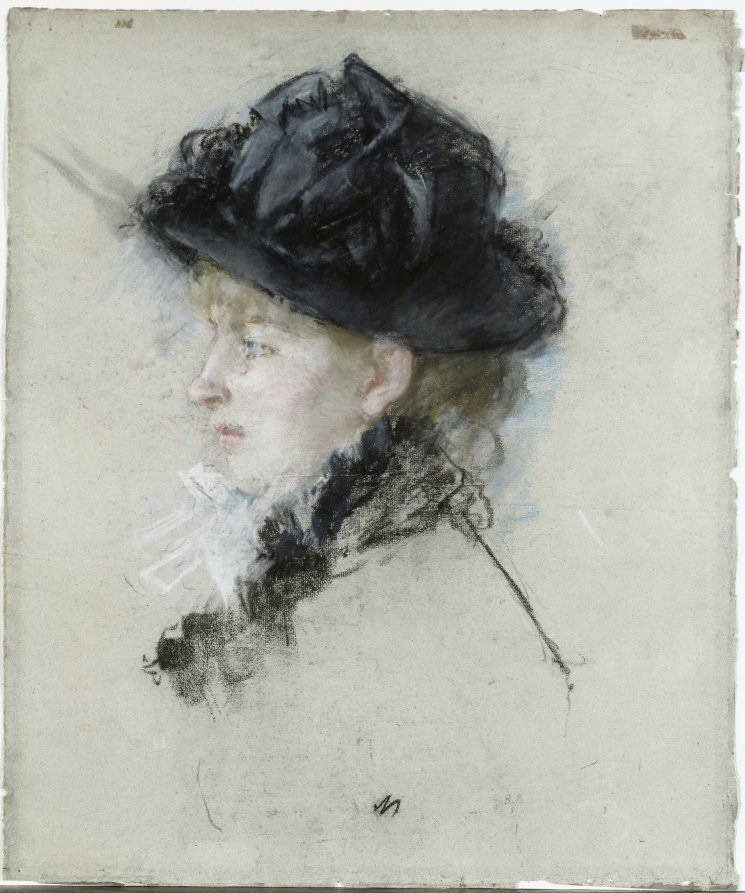
莫里索在十九世纪法国女性受限的条件下学习绘画,成为印象派展览的创始参与者。题材包括亲人、花园及家庭和近郊生活。后期用笔与描绘更为开放活跃,同时保留题材和媒介的多样性。
博物馆传记原文(英文)
Born into a prosperous family, Berthe Morisot was encouraged at an early age to become an amateur artist. Along with her sister Edma, she began her studies with Geoffroy-Alphonse Chocarne (act. 1838-1857), a painter trained in the neoclassical tradition. In 1858 the sisters entered the studio of Joseph-Benoît Guichard (1806-1880), a student of Ingres (q.v.) and Delacroix (q.v.). Through Guichard they met Corot (q.v.) in 1861, under whose encouragement they began to paint out of doors near Pontoise as well as in Normandy and Brittany. Berthe Morisot exhibited at the Salon from 1864 until 1873. Fantin-Latour (q.v.) introduced her to Manet (q.v.) around 1867. They developed a close friendship, and Morisot modeled for him many times (see Manet, Berthe Morisot, no. 141). In 1874 she married his brother, Eugène, and that same year began participating in the impressionist exhibitions, never to show at the Salon again. Four years after their marriage, the couple's only child, Julie, was born on 14 November 1878 and would become a main source of artistic inspiration. Morisot matured as a central member of the group of impressionists. Her home became a meeting place for painters and writers alike, including Renoir (q.v.), Degas (q.v.), Mary Cassatt (1845-1926), and Stéphane Mallarmé. She participated in the Drouot sale of 1875, where the artists were ridiculed extensively. Her paintings, however, fetched slightly higher prices than those of Renoir, Monet (q.v.), and Sisley (q.v.). Morisot made pastels and watercolors as well as oil paintings, and during the final years of her life she experimented with lithography and drypoint etching.
艺术家传记 · 克利夫兰艺术博物馆 · CC0生涯作品选读
所选作品并非完整目录。推断生涯顺序之前,请先阅读日期范围及作者归属。
- 01
1873
1873
阅读
- 材料与技法
- 布面油画
- 作者归属与角色
- 博物馆归属记录
- 收藏与来源
- 克利夫兰艺术博物馆
博物馆原文说明
Morisot’s sister, Edma, posed for this painting of a woman seated on her shawl in a field, her eyes on the pages of a book, with a parasol and fan discarded on the grass. Her white dress reflects the light and shadows of the outdoor setting; its delicate floral pattern echoes the meadow’s wildflowers.X-ray examination reveals that Morisot revised Edma’s eyes, which previously looked directly at the beholder, in a manner more typical of Manet’s figures (see The Railway on view in this gallery). Whereas women in Manet’s paintings often return the viewer’s look, Morisot’s figures are usually absorbed in tasks or private reflection.
馆藏文字 · 克利夫兰艺术博物馆 · CC0 - 02
1889
1889
绘画课(贝尔特·莫里索与女儿作画)
- 材料与技法
- 干刻
- 作者归属与角色
- 博物馆归属记录
- 收藏与来源
- 克利夫兰艺术博物馆
博物馆原文说明
Encouraged by the Impressionist Mary Cassatt and the poet Stéphane Mallarmé, Morisot experimented with printmaking between 1887 and 1889. In this drypoint, a technique in which a sharp tool is used to scratch lines onto a copper plate, Morisot looks directly at the viewer—as if drawing our portrait—while 11-year-old Julie observes her mother at work.
馆藏文字 · 克利夫兰艺术博物馆 · CC0 - 03
1890
1890
少年圣约翰
- 材料与技法
- 浅蓝帘纹纸粉彩
- 作者归属与角色
- 博物馆归属记录
- 收藏与来源
- 克利夫兰艺术博物馆
博物馆原文说明
In the spring of 1890 Berthe Morisot and her husband, Eugène Manet, rented a house with a garden overlooking the Seine River in the rural French town of Mézy. Morisot worked in the attic studio while the pair was there. A young boy from the village served as the model for this pastel, one of several studies for a full-length painting of Saint John the Baptist with his cross. In this drawing, Morisot developed the loose and sketchy marks that would characterize her final canvas.
馆藏文字 · 克利夫兰艺术博物馆 · CC0
比较材料、风格与色彩
《阅读》以油彩记录白衣上的反射光,1889年的绘画课将注意力转向制作与学习,1890年的粉彩则使用干性色材而非油彩。比较衣物、轮廓及背景如何保持开放,不要把所有松动笔触都当作未完成。
材料
这种材料能产生什么效果?请区分设计、原物与后来的印本或铸件。
风格
比较视点、边缘、构图及笔迹。哪些选择持续存在,哪些发生变化?
色彩
比较调色、对比及光线,同时考虑载体、印刷、表面处理与老化。
资料来源与延伸阅读
本项目原创教育性阐释;馆藏原文另行注明。每件选例均链接来源,未展示图像的参考条目不加入比较时间轴。