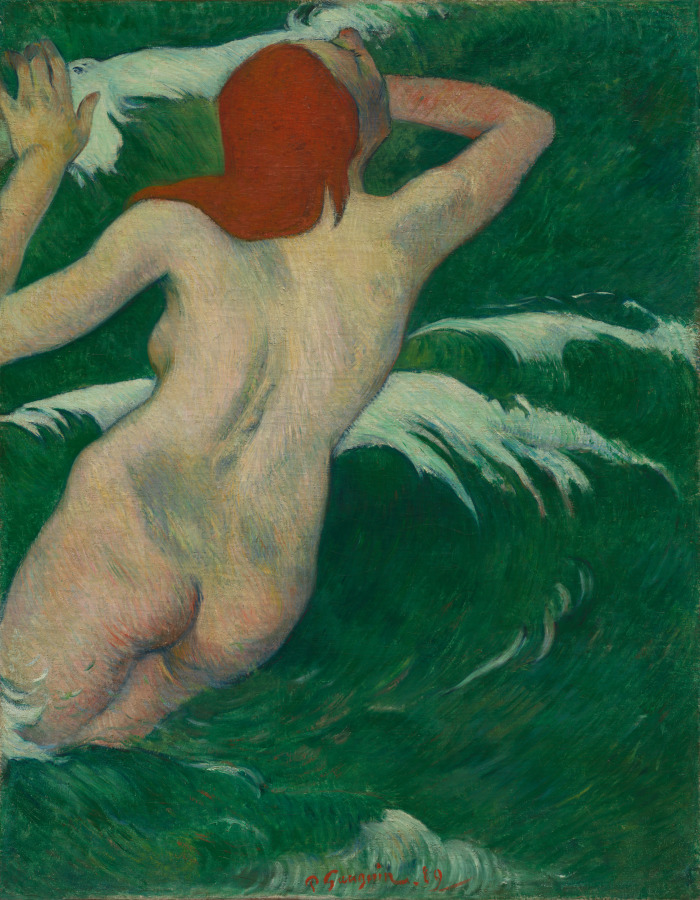
生平与创作经历
高更离开金融职业投身艺术,在法国艺术圈活动后前往塔希提及马克萨斯群岛,绘画逐渐结合简化色彩与象征题材。其波利尼西亚作品也必须放在法国殖民权力及不平等关系中理解。
博物馆传记原文(英文)
Gauguin spent the first seven years of his life with his mother and great uncle in Peru. In 1855 his mother took him back to France where he attended boarding school. He joined the merchant marine when he was seventeen and began traveling around South America. When Gauguin's mother died in 1868, Gustave Arosa, an art collector and photographer, became his legal guardian. Arosa's collection included works by Corot (q.v.), Courbet (q.v.), Delacroix (q.v.), and the Barbizon painters, and it was he who would encourage Gauguin to start painting. In 1872 Arosa found a job for Gauguin at a brokerage firm, giving him financial security. The following year he married a Danish woman, Mette Gad. Gauguin had already started painting and sculpting in his spare time and first exhibited at the Salon in 1876 with a landscape.1 He was asked by Pissarro (q.v.) and Degas (q.v.) to participate in the fourth impressionist exhibition in 1879, where from then on he would exhibit regularly. Durand-Ruel began purchasing his paintings, and in turn Gauguin started to collect the works of his colleagues, such as Manet (q.v.) and Renoir (q.v.) and, in particular, Cézanne (q.v.) and Pissarro. He went to Pontoise in 1882, where he painted with Cézanne and Pissarro, who along with Degas continued to influence him at this period. In 1883 Gauguin decided to become a full-time artist. In 1884 he moved with his wife and children to Rouen and then to Copenhagen, but he failed to earn a comfortable living. He returned to Paris in 1886 and met ceramicist Ernest Chaplet (1835-1909), who introduced him to his métier. Gauguin distanced himself from impressionism and in 1888 worked in Pont-Aven with Émile Bernard (1868-1941), who had been experimenting with creating compositions using flat areas of color and dark outlines (cloissonism). Gauguin also studied Japanese prints and Indonesian art. The impact of these influences is evident in Gauguin's Vision after the Sermon: Jacob Wrestling with the Angel (1888, National Gallery of Scotland, Edinburgh), so far removed from his earlier impressionist style. Succumbing to van Gogh's (q.v.) many requests, Gauguin agreed to travel to Arles and paint with the artist; their characters, however, proved incompatible. Theo van Gogh, who worked for Boussod Valadon & Cie, would in the meantime sell Gauguin's work. For the next two years, Gauguin traveled often around Brittany. In search of a more pure and unspoiled culture, he auctioned off his paintings in 1891 in order to finance a journey to Tahiti. Upon his arrival, he was disappointed to find many expatriates and developed areas, yet he was still able to capture in his works an uncultivated spirit. He not only made paintings but also created bold woodcuts and sculptures and was an avid writer. Gauguin returned to France in 1893, where he was given a solo exhibition by Durand-Ruel that was not particularly successful. He decided to leave Europe again in 1895, moving to Tahiti and later to Hivaoa, a more remote island in the Marquesas. Because he abandoned naturalistic colors and used formal distortions in order to achieve expressive compositions, Gauguin's work became an inspiration for many subsequent artists. 1. Possibly Wildenstein 1964, no. 12.
艺术家传记 · 克利夫兰艺术博物馆 · CC0生涯作品选读
所选作品并非完整目录。推断生涯顺序之前,请先阅读日期范围及作者归属。
- 01
1870年代
1870年代
母与子(正面)
- 材料与技法
- 黑粉笔
- 作者归属与角色
- 博物馆归属记录
- 收藏与来源
- 克利夫兰艺术博物馆
- 02
1891
1891
塔希提女性头像
- 材料与技法
- 羊皮纸石墨、擦染及石墨洗染
- 作者归属与角色
- 博物馆归属记录
- 收藏与来源
- 克利夫兰艺术博物馆
博物馆原文说明
This drawing belongs to a group of highly finished portrait drawings of Tahitians made by Paul Gauguin shortly after his arrival in the South Seas. While getting used to this new place, Gauguin initially avoided painting, preferring first to familiarize himself with the landscape and people through observation and drawing. The meticulous quality of this graphite study suggests that it was made from life. The woman’s noble face and enigmatic expression allude to the spirituality and melancholy that Gauguin sought to conjure in his Polynesian work.
馆藏文字 · 克利夫兰艺术博物馆 · CC0 - 03
1902
1902
召唤
- 材料与技法
- 布面油画
- 作者归属与角色
- 博物馆归属记录
- 收藏与来源
- 克利夫兰艺术博物馆
博物馆原文说明
Painted on a remote island in Polynesia a year before the artist's death, The Call belongs to a series of late works that explore the mysteries of life and death. Two women stand with bare feet, as if on sacred ground. One woman gestures to someone outside the picture, perhaps responding to a "call" from fate or destiny. Gauguin realized his ambition of painting from memory and the imagination through such mysterious, dreamlike images.
馆藏文字 · 克利夫兰艺术博物馆 · CC0
媒介、笔触与色彩
媒介与表面
素描、绘画及版画是并行路径,媒介变化不构成单一阶梯。
笔迹与结构
强调轮廓与简化平面,减少传统塑形并强化象征安排。
色彩与光线
非自然主义色彩营造情绪,需结合殖民与想象语境理解。
资料来源与延伸阅读
本项目原创教育性阐释;馆藏原文另行注明。每件选例均链接来源,未展示图像的参考条目不加入比较时间轴。