c. 1600s–1800s
Dates overlap and vary by place; they are not strict boundaries.
Print and painting tradition
A movement, period and school are different kinds of historical grouping.
Associations are checked against museum records rather than assigned from dates alone.
Why it emerged
In Edo-period cities, commercial publishing served audiences interested in actors, fashion, pleasure districts and later famous places. Woodblock prints were collaborative products involving designers, carvers, printers and publishers. Urban demand and technical changes encouraged colour printing; official regulation and censorship also shaped what could appear.
Key artists and contributions
Kitagawa Utamaro
Developed closely framed portraits of women within the commercial culture of beauty images.
Katsushika Hokusai
Made landscape series and striking compositional experiments central to a varied print practice.
Utagawa Hiroshige
Used weather, changing viewpoints and seasonal atmosphere in famous-place series.
What changed afterwards
Exported prints became a resource for European Japonisme, including experiments with cropping, flat colour and asymmetry. That reception was selective: Japanese audiences and makers had their own purposes, and Western influence stories do not exhaust the prints’ meanings.
Sources and further reading
Original educational overview, informed by the resources below. Artist examples are selective; they are not a complete membership list.
Works in this collection
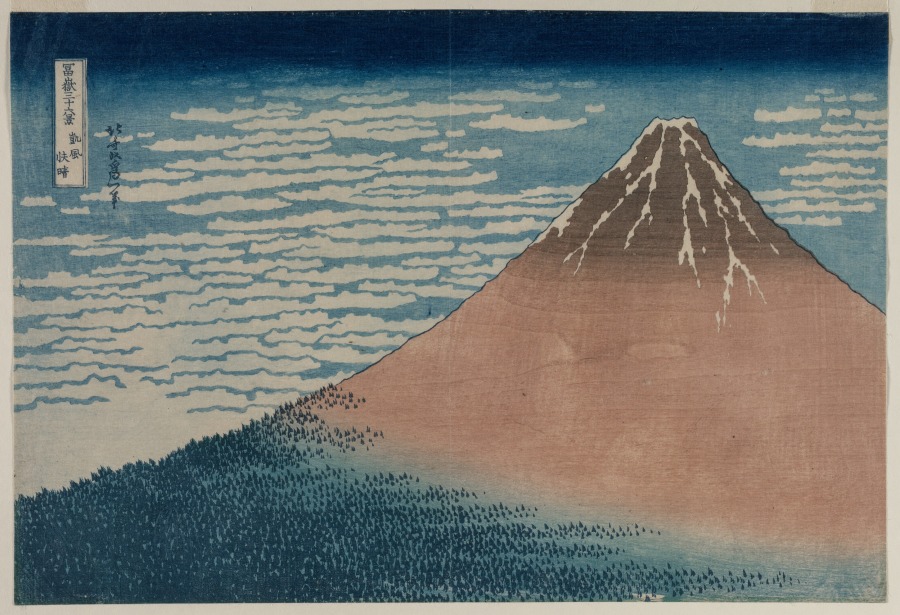 ↗
South Wind, Clear Sky, from Thirty-Six Views of Mount Fuji
Katsushika Hokusai
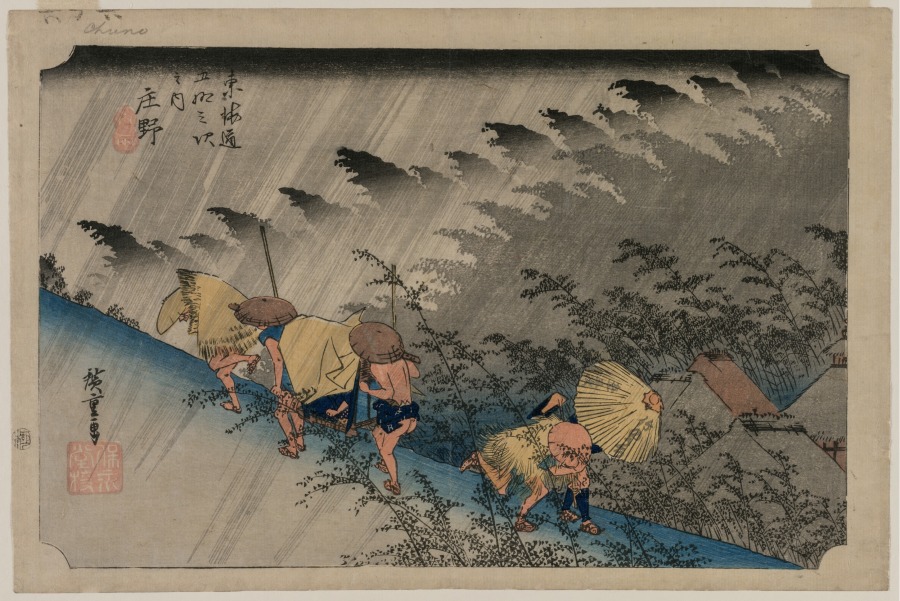 ↗
Driving Rain at Shōno, from Fifty-Three Stations of the Tokaidō
Utagawa Hiroshige
Movement and school labels are interpretive tools. Individual works can cross boundaries, and an artist’s entire career is not assigned to a single movement.