c. 1600s–1800s
Dates overlap and vary by place; they are not strict boundaries.
Court painting traditions
A movement, period and school are different kinds of historical grouping.
Associations are checked against museum records rather than assigned from dates alone.
Why it emerged
From the sixteenth century onward, distinct courts in Rajasthan and the northern hills supported painting tied to royal identity, devotion, poetry and musical modes. Encounters with Mughal artists enriched existing practices. Rajput painting is a broad grouping covering different regional histories; Pahari hill traditions are often discussed alongside it but should not be collapsed into one style.
Key artists and contributions
Sahibdin
Organised vividly coloured devotional narratives at the Mewar court.
Nihal Chand
Developed idealised, lyrical figures associated with the Kishangarh court.
Nainsukh
In the related Pahari tradition, portrayed courtly life with unusually intimate observation.
What changed afterwards
These traditions sustained varied ways of linking landscape, mood and narrative. Modern scholarship has recovered individual hands and family workshops, replacing the assumption that every court picture was anonymous or interchangeable.
Sources and further reading
Original educational overview, informed by the resources below. Artist examples are selective; they are not a complete membership list.
Works in this collection
 ↗
Maru Ragini, from a Ragamala (Garland of Melodies)
Creator not recorded
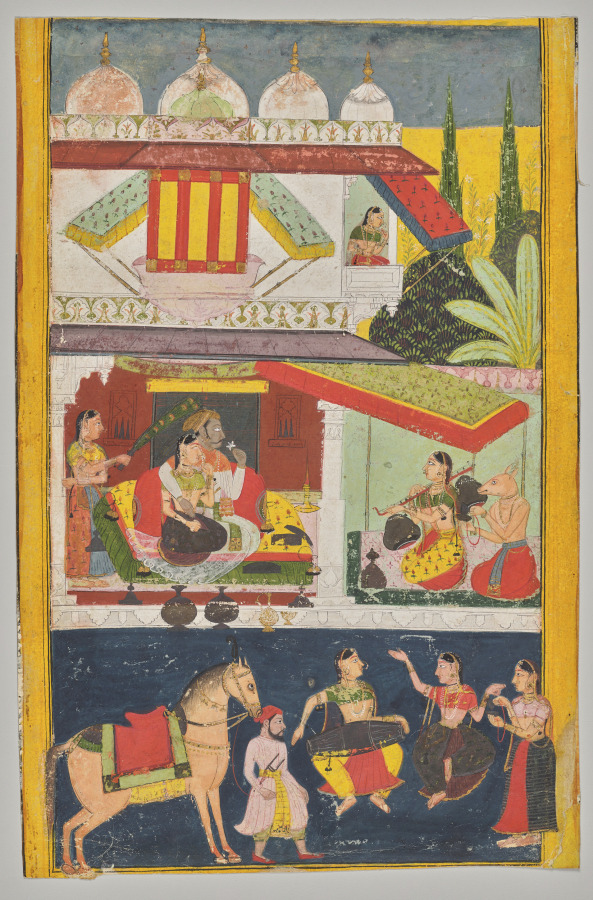 ↗
Shri Raga, from a Ragamala
Creator not recorded
Movement and school labels are interpretive tools. Individual works can cross boundaries, and an artist’s entire career is not assigned to a single movement.