1800s–early 1900s
Dates overlap and vary by place; they are not strict boundaries.
A souvenir could become satire
Painters serving pilgrims and urban buyers moved beyond religious subjects to contemporary social life. Economical figures and plain backgrounds made gestures and pointed jokes immediately legible.
Associations are checked against museum records rather than assigned from dates alone.
Why it emerged
In nineteenth-century colonial Kolkata, migrant patua painters found buyers among pilgrims and urban visitors near the Kali temple. Affordable paper and ready-made colours supported fast production of single-sheet pictures. Religious subjects shared space with satire, scandal and changing social roles, connecting devotional souvenirs with the expanding city’s public life.
Key artists and contributions
Anonymous patua workshops
Collective workshop production established the flowing outlines and economical figures associated with Kalighat.
REPRESENTATIVE WORKEnglish Babu (Native Indian Clerk) Holding a Hookah ↗
c. 1890
Anonymous Kalighat workshop exampleThe Cleveland Museum of ArtNibaran Chandra Ghosh
Named works and attributed sketches help document individual practice within the wider tradition.
View artwork at museumReference entry · image not reproducedREPRESENTATIVE WORKA woman putting a rose in her hair ↗
c. 1900
Victoria and Albert Museum, IS.31-1952Kanai Lal Ghosh
His surviving animal imagery documents the tradition’s continuing work into the twentieth century.
View artwork at museumReference entry · image not reproducedREPRESENTATIVE WORKA cat with a fish ↗
c. 1920s
Victoria and Albert Museum, IS.45-1952
What changed afterwards
Cheap commercial prints challenged the original urban market, but painters continued and renewed the tradition elsewhere in Bengal. Contemporary makers, including Anwar Chitrakar, show that it remains a living practice rather than only a vanished nineteenth-century genre.
Sources and further reading
Original educational overview, informed by the resources below. Artist examples are selective; they are not a complete membership list.
Works in this collection
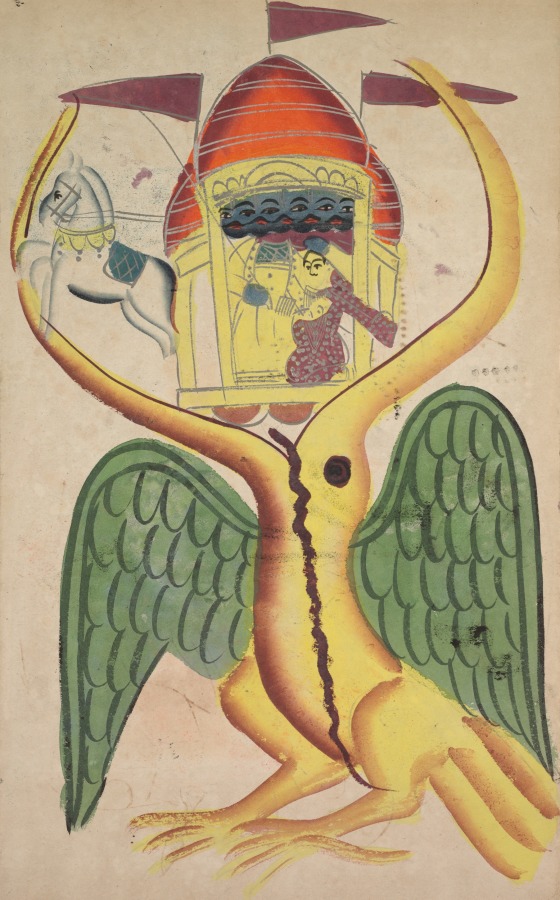 ↗
Jatayu hinders Ravana’s chariot, trying to prevent the abduction of Sita (recto), from a Kalighat album
Creator not recorded
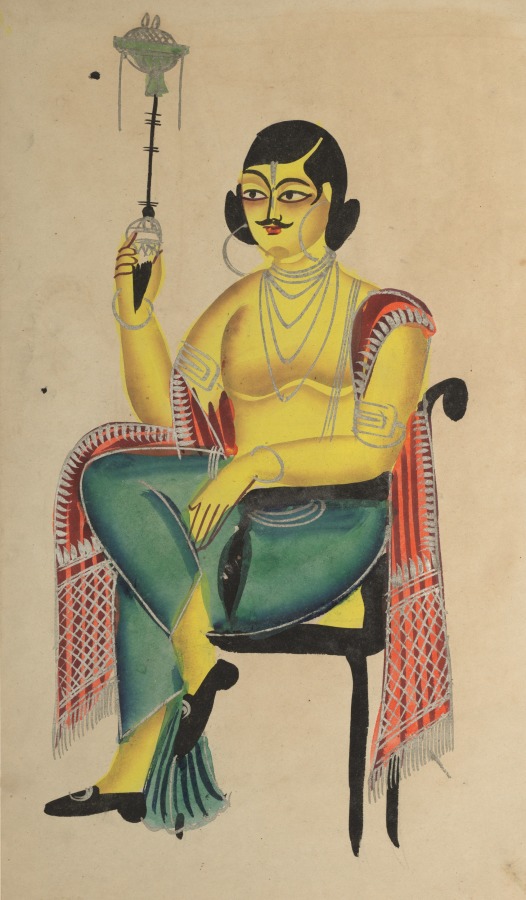 ↗
English Babu (Native Indian Clerk) Holding a Hookah
Creator not recorded
Movement and school labels are interpretive tools. Individual works can cross boundaries, and an artist’s entire career is not assigned to a single movement.