from the early 1600s
Dates overlap and vary by place; they are not strict boundaries.
School and lineage
A movement, period and school are different kinds of historical grouping.
Associations are checked against museum records rather than assigned from dates alone.
Why it emerged
In early-seventeenth-century Kyoto, wealthy merchants and aristocratic cultural networks renewed interest in classical Japanese literature and visual traditions. Rinpa connected painting, calligraphy and designed objects through bold pattern and seasonal imagery. Its artists often learned by studying earlier works rather than belonging to one continuous, hereditary workshop.
Key artists and contributions
Hon’ami Kōetsu
Combined calligraphic rhythm with decorated papers and work across different crafts.
Tawaraya Sōtatsu
Recast classical themes through dramatic surfaces, pattern and simplified forms.
Ogata Kōrin
Developed bold rhythmic designs that travelled between screens, textiles and objects.
What changed afterwards
Pattern books and later admirers, including Sakai Hōitsu, renewed its designs across generations. Its history shows influence working through revival and reinterpretation, rather than a continuous teacher-to-student chain.
Sources and further reading
Original educational overview, informed by the resources below. Artist examples are selective; they are not a complete membership list.
Works in this collection
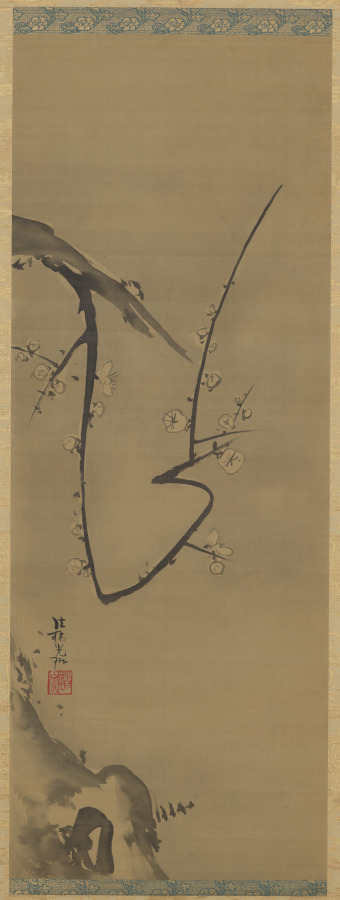 ↗
Plum Tree
Ogata Kōrin
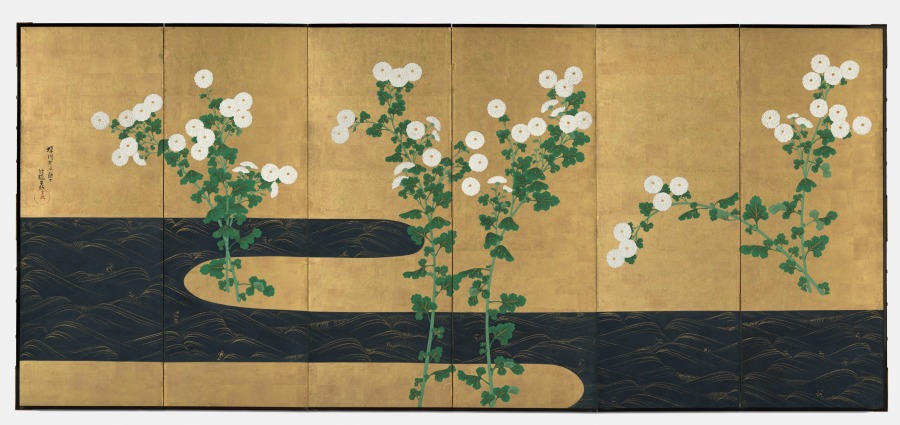 ↗
Chrysanthemums by a Stream
Possibly by Ogata Kōrin
Movement and school labels are interpretive tools. Individual works can cross boundaries, and an artist’s entire career is not assigned to a single movement.