from 1848
Dates overlap and vary by place; they are not strict boundaries.
Movement
A movement, period and school are different kinds of historical grouping.
Associations are checked against museum records rather than assigned from dates alone.
Why it emerged
Founded in Britain in 1848, the Pre-Raphaelite Brotherhood resisted conventions they associated with academic painting after Raphael. Close study of nature, early Italian art and literary or biblical sources offered alternatives. Their reform developed within Victorian debates about faith, industrial society and the relationship between art and moral seriousness.
Key artists and contributions
John Everett Millais
Combined painstaking natural detail with emotionally charged narrative scenes.
William Holman Hunt
Used carefully observed objects as dense religious and moral symbols.
Dante Gabriel Rossetti
Connected poetry and painting through medieval subjects and psychologically intense figures.
What changed afterwards
Later associates, including Edward Burne-Jones and William Morris, carried related concerns into decorative art. These networks fed Arts and Crafts and Symbolist imagery, extending the legacy beyond the short life of the original Brotherhood.
Sources and further reading
Original educational overview, informed by the resources below. Artist examples are selective; they are not a complete membership list.
Works in this collection
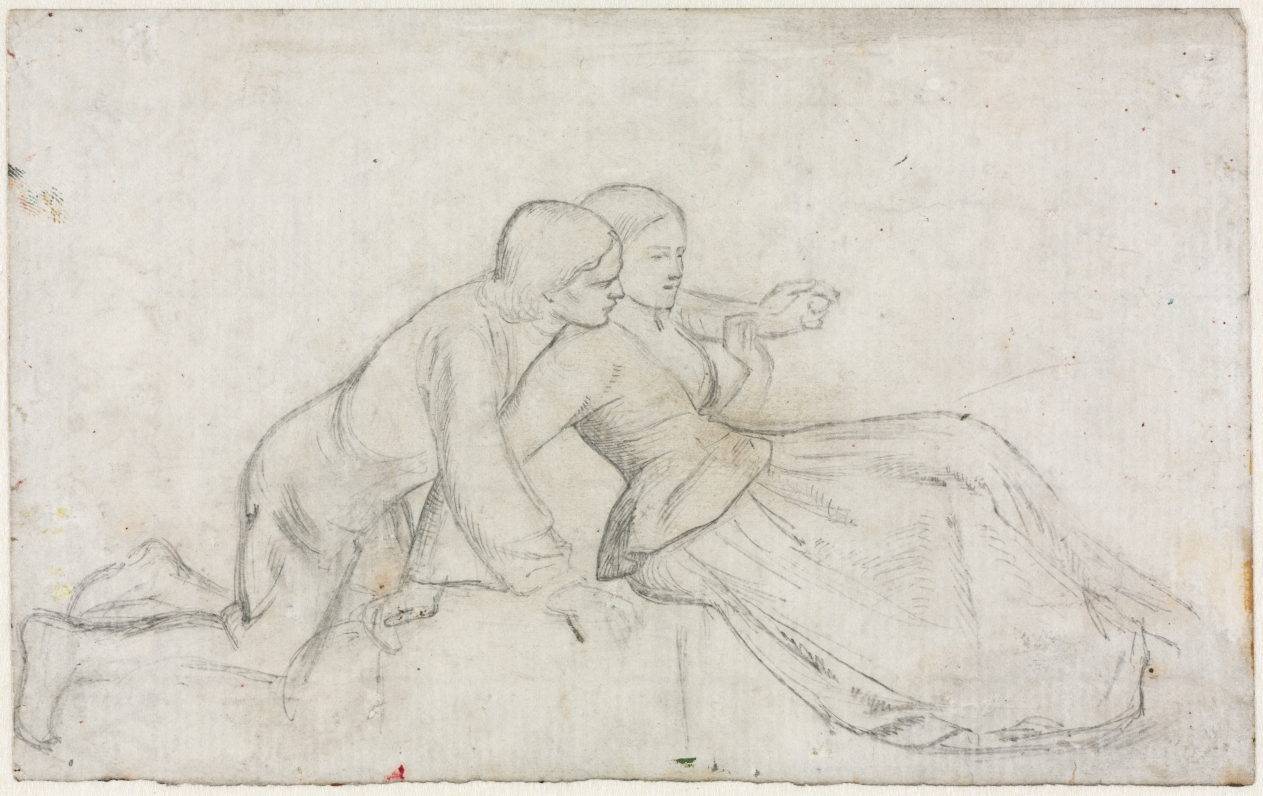 ↗
Study for "The Hireling Shepherd"
William Holman Hunt
 ↗
The Coral Necklace
Frederick Sandys
Movement and school labels are interpretive tools. Individual works can cross boundaries, and an artist’s entire career is not assigned to a single movement.