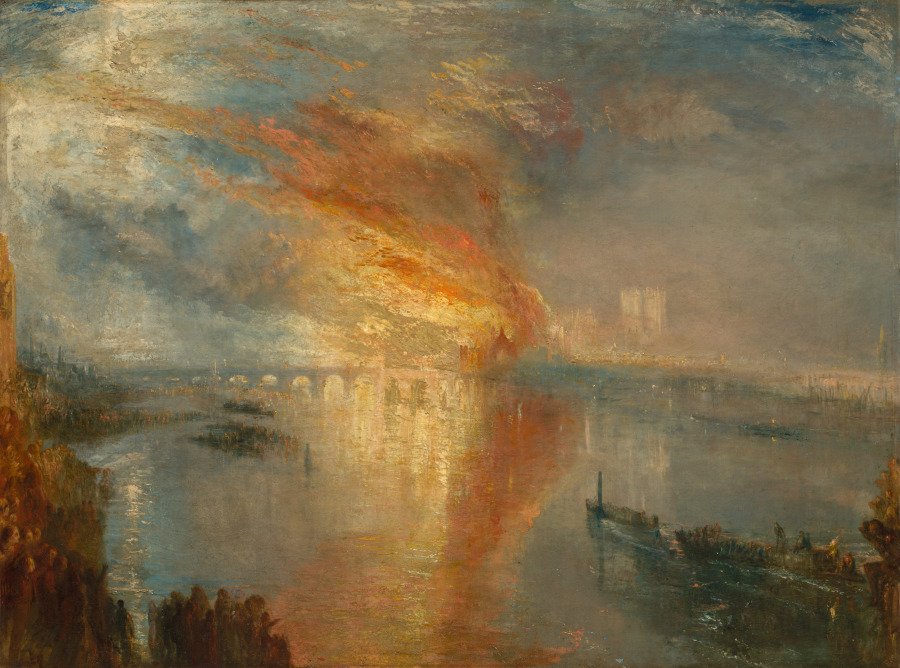
Life and career
Turner trained in the British watercolour and exhibition world before becoming a prominent landscape painter. Travel, print projects and study of light expanded his subjects from recognisable topography to atmospheric experiments. Late watercolours show continued command of specific places even when forms approach dissolution in light.
Museum biography (English)
Joseph Mallord William Turner, the supreme landscape painter of the romantic era, had the exceptional good fortune to be the son of a Covent Garden barber and wigmaker who thoroughly supported his aspirations to paint pictures. As an adolescent, Turner colored engravings for the print sellers and apprenticed with architectural draftsman Thomas Malton (1726-1801). Although he entered the Royal Academy Schools in 1789, Turner's substantive artistic training came from his numerous self-conducted topographical drawing tours of the British Isles in the early 1790s and from his camaraderie with Thomas Girtin (1775-1802), with whom he copied the masterworks of landscape watercolorist John Robert Cozens (1752-1799) in the collection of Dr. Thomas Monro (1759-1833). Turner submitted his first oil painting, a seascape, for exhibition at the Royal Academy in 1796 and was elected an associate member three years later, at the earliest permissible age. Devoted to the academy's lofty mission, as it had been articulated by the recently deceased Sir Joshua Reynolds (1723-1792) in his annual lectures to the students of the academy, Turner would relish his election as a full academician in 1802 and would serve as professor of perspective from 1807 until 1837. His masterpieces of the early decades (and there seems an endless succession of works with title to that distinction) were either homages to past masters of landscape painting or entirely personal interpretations of the most extraordinary range of naturalistic effects and subjects. Whether it was The Fifth Plague of Egypt (1800, Indianapolis Museum of Art) and its amalgam of allusions to Nicolas Poussin (1594-1665) and Richard Wilson (1714-1782), The Dort Packet-Boat from Rotterdam Becalmed (1818, Yale Center for British Art, New Haven), with its overt tribute to Aelbert Cuyp (1620-1691), or The Fall of an Avalanche in the Grisons (1810, Tate Gallery, London), with its unprecedented invention of horrific naturalistic detail that challenged conventional notions of the sublime in art, the net effect of Turner's achievement was to elevate landscape painting to a status within the traditional hierarchy of genres that it had rarely enjoyed since the seventeenth century. Unlike Constable (q.v.), Turner was an indefatigable traveler abroad. His first visit to Switzerland in 1802 resulted in a spectacular series of exhibition watercolors that boldly established watercolor painting as a vital medium of original expression. A tour of Belgium, the Netherlands, and the Rhine in 1817 was followed by his first protracted stay in Italy in 1819. After 1820 summer excursions to France, Germany, Switzerland, Italy, and especially Venice were almost annual occurrences. Gradually, and primarily after the 1819 Italian sojourn, Turner's palette lightened. Traditional notions of chiaroscuro, of alternating bands of light and dark earth colors, yielded to compositions orchestrated in brighter hues, in which the various colors move across the painted surface almost at will, little respecting the forms they describe but in perfect balance. During the 1820s and early 1830s Turner committed vast amounts of his creative capital to the production of literary and travel illustrations. These kept an entire generation of engravers employed for several decades. Despite the tendency of his era to stigmatize reproductive engraving as an inferior instrument of artistic presentation, Turner was preoccupied with its processes and potential, acutely aware that, long after his pigments had faded, his reputation would be secure in the more durable brilliance of the engraver's deftly crafted reproductions. A second trip to Italy in 1828 may partially account for the heightened coloring of Ulysses Deriding Polyphemus (1828, National Gallery, London), which John Ruskin described as a pivotal picture in Turner's career. But there was very little falling off in either technical or thematic invention during the last decades of Turner's life. In major oils like Snow Storm-Steam Boat Off a Harbor's Mouth (1842, Tate Gallery, London) and Rain, Steam and Speed (1844, National Gallery, London) and no less measure in the series of elaborately finished Swiss watercolors executed on commission at the end of his life, natural forms occupy an uncertain place between concrete reality and total dissolution by light into the colors and images of what Monet (q.v.) admiringly called the "exuberant romanticism of Turner's fancy." Perspective can be intentionally distorted and the color schemes can approach the brazenly artificial, yet somehow the fundamental truth of Turner's vision, his faith in the supreme forces of nature and in the artist's preeminence as the mediator of that experience, continues to persuade.
Creator biography · The Cleveland Museum of Art · CC0Works across a career
Selected examples, not a complete catalogue. Read date ranges and attributions before inferring a career sequence.
- 01
c. 1793
c. 1793
Hereford Cathedral
- Material / technique
- graphite
- Attribution / role
- Museum attribution
- Collection / source
- The Cleveland Museum of Art
- 02
1814
1814
Solitude
- Material / technique
- etching and mezzotint
- Attribution / role
- Museum attribution
- Collection / source
- The Cleveland Museum of Art
- 03
1845
1845
Flüelen, from the Lake of Lucerne
- Material / technique
- watercolor with gouache and scratch-away
- Attribution / role
- Museum attribution
- Collection / source
- The Cleveland Museum of Art
Museum catalogue note
In this watercolor, created late in his life, J.M.W. Turner depicted the small Swiss town of Flüelen and its shimmering reflection out of violet-colored mist. The work belongs to a group of highly finished works that the artist created during several summer trips to Switzerland between 1841 and 1845. The swirling vortex of light underscores the grandeur of nature, while the inclusion of figures going about their daily lives within the vastness of the Alps is a reminder of the reality of the scene. At the time he painted this view, Turner was considered the great master of Romantic landscape painting in England.
Collection text · The Cleveland Museum of Art · CC0
Materials, marks and colour
Media and surface
Graphite, printmaking and watercolour each test a different relation between detail and atmosphere.
Marks and structure
Defined topography can loosen into washes, scraped highlights and suggestions of form.
Palette and light
Late watercolours use luminous light-dark and warm-cool relationships without abandoning specific places.
Sources and further reading
Original educational interpretation; catalogue descriptions are separately credited. Each study links to its source. Reference entries without images are not added to the comparison timeline.