Life and career
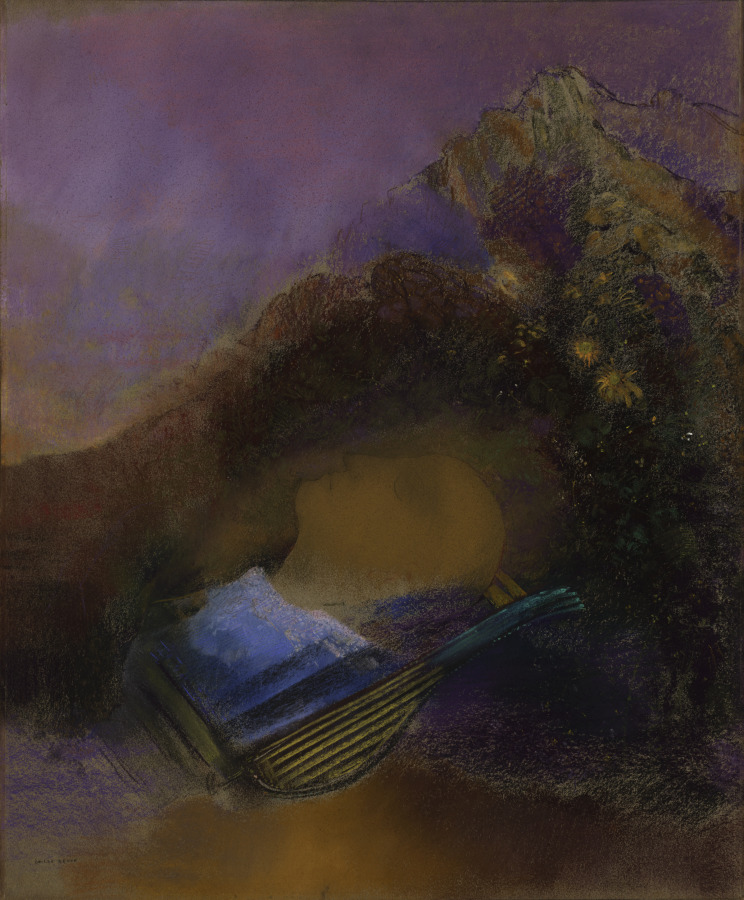
Redon developed an imaginative art through drawing and printmaking before colour became increasingly prominent in his later work. Literature, music and natural forms offered starting points for images that resist literal explanation. His career includes both dark graphic visions and luminous flowers, without requiring a simple change from despair to happiness.
Museum biography (English)
A leader of the symbolist movement in France, Odilon Redon was born in Bordeaux in 1840 and grew up in the surrounding region. During his early years he studied drawing, architecture, and the violin. A friendship with Armand Clavaud, a local botanist and philosopher, stimulated Redon's passion for romantic art and literature. In 1864, after a brief and discouraging period of instruction with Gérôme in Paris, Redon returned to Bordeaux, where he studied printmaking with Rodolphe Bresdin (1825-1885). Deploring the emphasis on rational, phenomenal experience in academic and naturalist art, Redon turned for inspiration to the imaginative paintings of Delacroix, the prints of Francisco José de Goya (1746-1828), and the poetry of Charles Baudelaire. In 1870, after military service in the Franco-Prussian War, Redon settled in Paris and produced his first Noirs. These visionary images, featuring floating eyes and severed heads born aloft on wings, reflect Redon's belief in the superiority of the imagination and fantasy, which he considered "the messenger of the unconscious." After producing his initial Noirs in charcoal, Redon discovered a method of transferring his drawings to lithography in 1876. Throughout the 1880s he continued to use charcoal, etching, and lithography as his primary media, and he produced twelve lithography albums before abandoning the genre in the late 1890s. During the 1880s Redon emerged as a leader of the symbolist reaction against impressionism. The publication in 1879 of his first lithographic album, Dans le rêve, followed by his first solo exhibition in 1881, attracted the admiration of J. K. Huysmans, who included illustrations by Redon in his novel À rebours (1884). Around the same time, Redon developed a personal and artistic relationship with poet Stéphane Mallarmé. Increasingly drawn into the public arena, Redon helped organize the Société des Artistes Indépendants in 1884. In 1886 he participated in the last impressionist exhibition and began showing with Les XX in Brussels. Redon's antinaturalist, visionary, art inspired many symbolist and Nabi artists, including Gauguin and Vuillard. Maurice Denis praised Redon as "our Mallarmé," and in 1892 critic Albert Aurier described Redon as a leader of the new "idealistic" tendency in art. After 1890 the focus of Redon's activity shifted from monochromatic drawings and prints toward exploring color in richly worked pastels. His innovations in luminous color, as seen in the pastel and oil paintings he exhibited at the Galeries Durand-Ruel in 1900 were greatly admired by Henri Matisse (1869-1954) and the Fauves. Awarded the Legion of Honor in 1903, Redon continued his leadership role in the avant-garde and in 1904 became a founding member of the Salon d'Automne. In 1913 forty of his works were selected for exhibition in the Armory Show, the most by any artist. Redon died at his home in Paris in the summer of 1916.
Creator biography · The Cleveland Museum of Art · CC0Works across a career
Selected examples, not a complete catalogue. Read date ranges and attributions before inferring a career sequence.
- 01
c. 1868
c. 1868
Melancholy
- Material / technique
- graphite on beige wove paper
- Attribution / role
- Museum attribution
- Collection / source
- The Cleveland Museum of Art
Museum catalogue note
Odilon Redon grew up near the massive Pyrénées mountains in southern France and their image recurred throughout his work. In a series of drawings made during the 1870s, Redon used the craggy surface and infinite reach of his native landscape to evoke a sense of solitude and isolation. The woman seen here, for example, leans forward and casts her eyes downward as if in resignation.
Collection text · The Cleveland Museum of Art · CC0 - 02
1893
1893
The Wing
- Material / technique
- lithograph
- Attribution / role
- Museum attribution
- Collection / source
- The Cleveland Museum of Art
- 03
1916
1916
Vase of Flowers
- Material / technique
- pastel
- Attribution / role
- Museum attribution
- Collection / source
- The Cleveland Museum of Art
Museum catalogue note
Inspired by Cleveland’s groundbreaking acquisitions of Odilon Redon’s artworks during the 1920s, local philanthropist and collector Leonard C. Hanna Jr. purchased this luminous pastel of a floral still life in 1937. Hanna acquired it from Jacques Seligmann, a dealer based in New York City and Paris who was fundamental in bringing 19th-century French art to American audiences. In 1939, Hanna loaned the pastel to the New York World’s Fair, where it represented Redon’s work. Those who saw it there were attracted to the vivid color and timeless subject, which preoccupied the artist at the end of his life.
Collection text · The Cleveland Museum of Art · CC0
Materials, marks and colour
Media and surface
Graphite and lithographic darks coexist with later dry, luminous pastel colour.
Marks and structure
Isolated forms, unusual scale and suggestive outlines move familiar motifs toward imagined worlds.
Palette and light
Dark tonal visions and saturated floral passages are complementary strands rather than a simple emotional reversal.
Sources and further reading
Original educational interpretation; catalogue descriptions are separately credited. Each study links to its source. Reference entries without images are not added to the comparison timeline.