Life and career
Wen Zhengming studied with Shen Zhou and became a central figure in Suzhou’s Wu-school networks. After a short, unhappy period at the imperial court, he returned to Suzhou in 1527. His long later career joined painting, calligraphy, poetry and the cultivation of friends, students and family successors.
Works across a career
Selected examples, not a complete catalogue. Read date ranges and attributions before inferring a career sequence.
- 01
c. 1525
c. 1525
Poem on Imperial Gift of an Embroidered Silk: Calligraphy in Running-Standard Script (xingkaishu)
- Material / technique
- Hanging scroll; ink on paper
- Attribution / role
- Museum attribution
- Collection / source
- The Cleveland Museum of Art
Museum catalogue note
A poem by the influential Wen Zhengming from Suzhou in southeastern China expresses Wen’s gratitude to the Jiajing emperor (reigned 1522–67) for a gift of embroidered silk bestowed in appreciation of his commendable service. The elegant, well-composed, and energetically written large characters in deep black ink reflect the handwriting of a distinguished scholar-artist. Works of calligraphy by Wen of this large scale are rare.The poem reads:As I expressed my gratitude to His Majesty by the Goldwater Bridge. This heavenly silk is embroidered with five colors.Resplendent it is, draping over my arm with [designs of] twin dragons.Having received such a gift, I [bowed] in shame over my lack of achievements. Humbly I returned to my rank to observe the grand ceremony.I wish His Majesty shall live on for myriad years,And the sun will always shine upon His trailing robe.
Collection text · The Cleveland Museum of Art · CC0 - 02
late 1530s
late 1530s
Old Pine Tree
- Material / technique
- handscroll; ink on paper
- Attribution / role
- Museum attribution
- Collection / source
- The Cleveland Museum of Art
Museum catalogue note
Here the natural appearance of a gnarled and vine-entangled pine has been transformed into a rhythmic abstraction of brushstrokes and ink tonalities, with unifying opposites—opening and closing, rising and falling—that provide the design across the horizontal scroll. The artist's inscription reads: "The force of change beyond restraint; / The dragon's whiskers are likened to a forest of spears."
Collection text · The Cleveland Museum of Art · CC0 - 03
1551
1551
Old Trees by a Wintry Brook
- Material / technique
- hanging scroll, ink and light color on paper
- Attribution / role
- Museum attribution
- Collection / source
- The Cleveland Museum of Art
Museum catalogue note
Wen Zhengming was one of the most celebrated calligraphers and painters during the Ming dynasty (1368–1644). His inscription, gracefully written in small characters on the upper left corner, reveals Wen’s emotional mood at that moment of creation. "In the fifteenth day of the fifth month, the year of xinhai [1551], [I], Zhengming, playfully write this Old Trees by a Wintry Brook at eighty-two [sui]." How should we understand a wintery landscape painted in the middle of spring? Was it simply inspired by a surprisingly late spring snow? Or can it be that the “wintery” brook reflects the octogenarian’s feelings about aging and his inevitable, approaching mortality? The junipers’ gnarled forms are a poignant symbol of aging and suffering, yet the ink-dot leaves on some branches suggest that the trees are still alive, awaiting the warmth of spring.
Collection text · The Cleveland Museum of Art · CC0
Materials, marks and colour
Media and surface
Painting and calligraphy share ink, brush and paper-based working methods.
Marks and structure
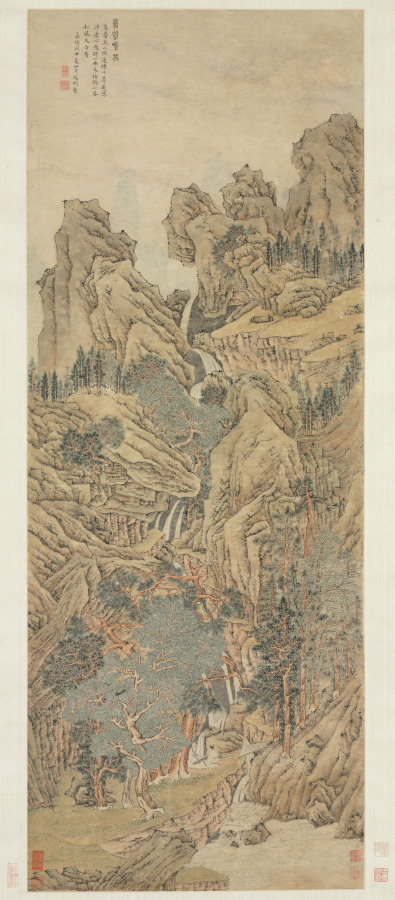
Fine controlled lines coexist with dense, rhythmic trees and rocks built through repeated marks.
Palette and light
Restrained colour leaves ink gradation, spacing and unpainted areas structurally important.
Sources and further reading
Original educational interpretation; catalogue descriptions are separately credited. Each study links to its source. Reference entries without images are not added to the comparison timeline.