Life and career
Shen Zhou belonged to a cultivated landowning family near Suzhou and did not pursue an official career. Painting, poetry, calligraphy and friendships formed interconnected parts of his life. Later generations regarded him as a foundational figure of the Wu school, although his practice ranged beyond any single landscape formula.
Works across a career
Selected examples, not a complete catalogue. Read date ranges and attributions before inferring a career sequence.
- 01
1468
1468
Yellow Chrysanthemums and Red Osmanthus in the Style of Wang Yuan
- Material / technique
- hanging scroll; ink on paper
- Attribution / role
- Museum attribution
- Collection / source
- The Cleveland Museum of Art
Museum catalogue note
Shen Zhou, a native from Suzhou, was descended from a prominent land-owning family with strong ties to literati culture. Because Shen Zhou never entered government service, he had ample opportunity to cultivate the arts of painting, poetry, and calligraphy.Chrysanthemums and red osmanthus both bloom in autumn. The deep orange osmanthus flowers emanate a characteristically sweet fragrance. According to his inscription on the painting, Shen Zhou sought to imitate the style of the Yuan dynasty (1271–1368) painter Wang Yuan. His color-filled brushstrokes and washes, however, anticipate the flower painting style of Yun Shouping, whose Peonies are also in the Cleveland Museum of Art collection, https://www.clevelandart.org/art/1967.192. The sheer size and complex composition of this scroll are impressive.
Collection text · The Cleveland Museum of Art · CC0 - 02
after 1490
after 1490
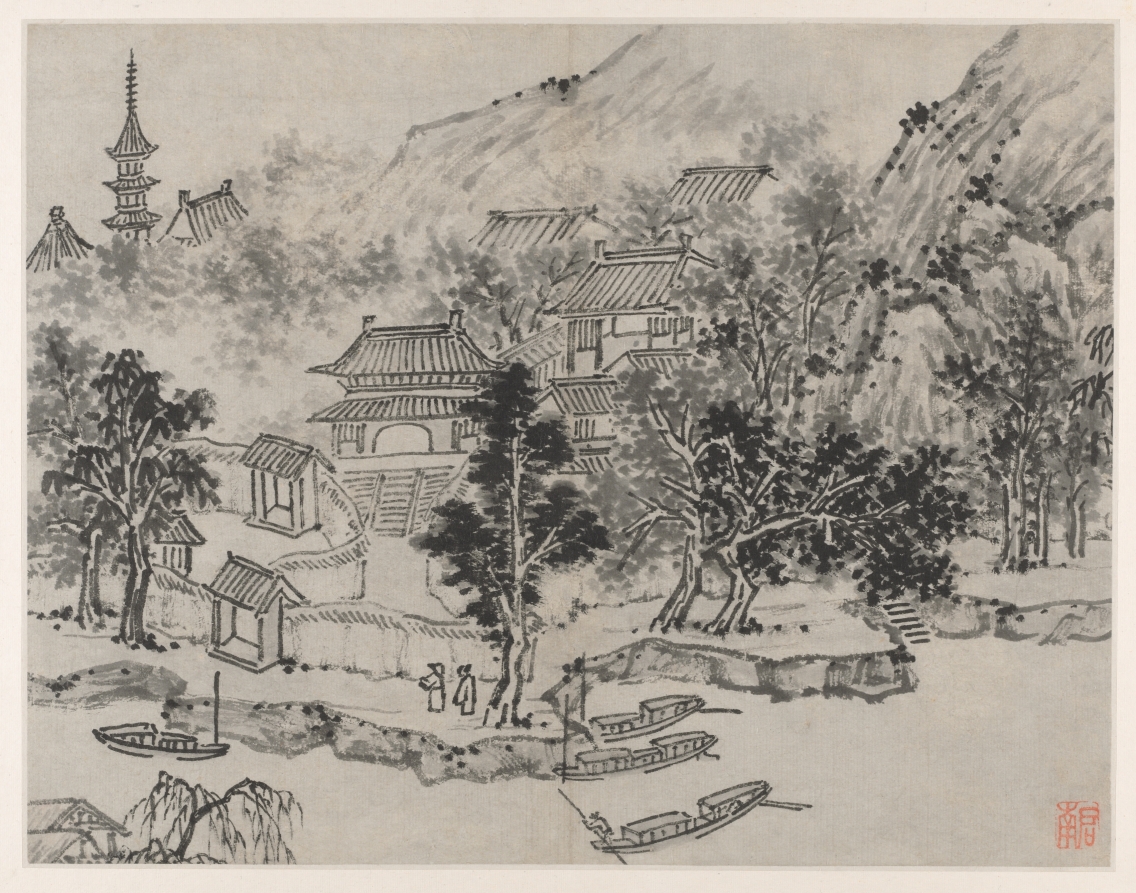
The Thousand Acres of Clouds, from Twelve Views of Tiger Hill, Suzhou
- Material / technique
- Album leaf; ink on paper or ink and slight color on paper
- Attribution / role
- Museum attribution
- Collection / source
- The Cleveland Museum of Art
Museum catalogue note
Views of Tiger Hill depicts a historic site a few miles northwest of Suzhou. The scenes simulate a visit from arriving by boat at the foot of the mountain to climbing to Cloudy Cliff Monastery. Representations of the artist’s mature style, Shen Zhou included views in subtle colors in the suite of monochrome scenes. A Suzhou native, Shen Zhou was supported by family wealth and rejected an official career in favor of life as a retired scholar. Turning to painting in midlife, he is regarded as the founder of the Wu School of painting, with its center in Suzhou.
Collection text · The Cleveland Museum of Art · CC0 - 03
1500
1500
Flowering Crab Apple
- Material / technique
- hanging scroll; ink on paper
- Attribution / role
- Museum attribution
- Collection / source
- The Cleveland Museum of Art
Museum catalogue note
Shen Zhou painted a broken branch (zhezhi 折枝) of crab apple, a fragment of nature rather than the full plant in its natural context. Shen uses calligraphic outlines in pure ink to depict the flower petals. The swift yet precise brushstrokes together with the slight S-shaped branch convey vitality. The inscription is a poem written by the artist, commenting on the lovely color and melancholic aura of the crab apple blossom. Shen Zhou is the founder of the Wu School, a group of scholars and officials active around Suzhou in eastern China, known for practicing painting and calligraphy in a refined and elegant style.
Collection text · The Cleveland Museum of Art · CC0
Materials, marks and colour
Media and surface
Ink on paper makes wet washes, dry brush and exposed support equally expressive.
Marks and structure
Calligraphic brush rhythms connect landscape texture, plant forms and written inscriptions.
Palette and light
Ink density often carries the tonal range; light colour supports rather than replaces brush structure.
Sources and further reading
Original educational interpretation; catalogue descriptions are separately credited. Each study links to its source. Reference entries without images are not added to the comparison timeline.