Life and career
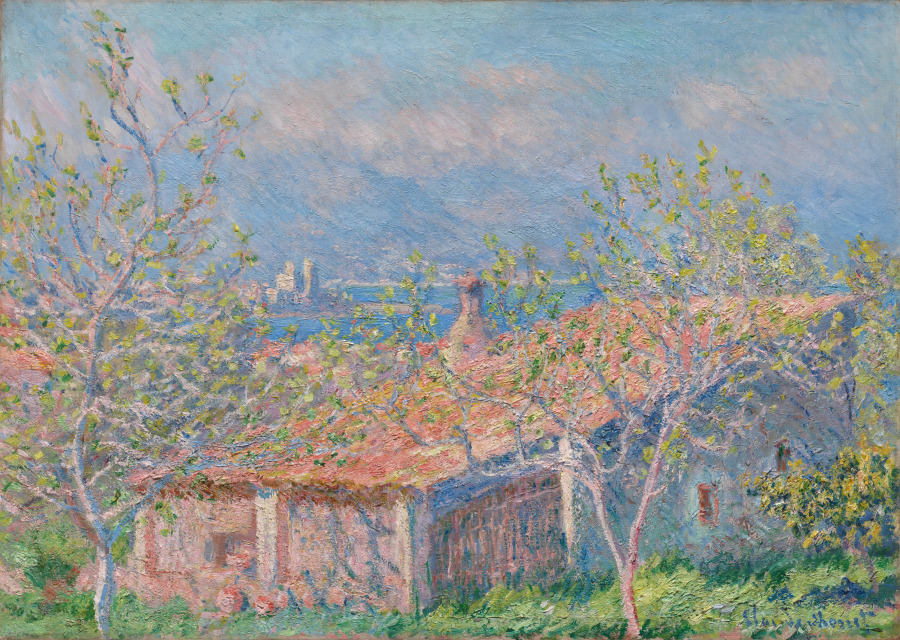
Monet’s early career included carefully observed still lifes and contemporary landscapes. He participated in the independent Impressionist exhibitions from 1874 and increasingly investigated repeated motifs under changing conditions. At Giverny he cultivated a garden that became a sustained late subject, culminating in expansive water-lily paintings.
Museum biography (English)
Claude Monet spent his youth in Le Havre in Normandy, where his father worked as a wholesale grocer. By the age of sixteen, he had exhibited some of his caricatures in an art supply store, leading to his acquaintance with Boudin (q.v.). It was Boudin who first encouraged him to paint out of doors. In 1859 Monet traveled to Paris, where he saw Boudin's salon debut and met Constant Troyon (1810-1865). A year later he joined the Académie Suisse, where he was introduced to Pissarro (q.v.), but his studies were interrupted in 1861 when he was drafted for a seven-year stint in the military. His family would pay for his release from military duties only if he gave up painting. Finding this unacceptable, Monet served for one year in Algeria before an early return to France to convalesce after a severe illness. In 1862 he met Jongkind (q.v.), another important influence on the young painter's development. Monet's father then allowed him to pursue his art career in Paris, where he entered the studio of the Swiss painter Charles Gleyre (1806-1874). He studied with Gleyre until 1864 and befriended Frédéric Bazille (1841-1870), Renoir (q.v.), and Sisley (q.v.), with whom he painted in the forest of Fontainebleau (Déjeuner sur l'herbe, 1865, two fragments in Musée d'Orsay, Paris). Monet first exhibited at the Salon of 1865 and would do so again in 1866, 1868, and 1880. In 1868 he shared a studio with Bazille and Renoir but was soon forced to leave Paris to escape his creditors. He took his mistress, Camille Doncieux, and their son, Jean, to Fécamp, then Étretat, and finally Saint-Michel. There Renoir provided hospitality, and the two also painted at the boating and bathing center of La Grenouillère on the Seine. In 1870 Monet married Camille and, to escape the Franco-Prussian War, left for London, where he remained for nine months and met Durand-Ruel, his first dealer. In the summer of 1871 he visited the Netherlands and then settled in Argenteuil, to the west of Paris. He converted a boat into a studio, as Daubigny (q.v.) had done before him, allowing him to explore different viewpoints for his landscapes. He assisted in the organization of the First Impressionist Exhibition in 1874, partly because Durand-Ruel's worsened business situation had prevented the dealer from buying his art. The following year he participated in the Hôtel Drouot sale with Morisot (q.v.), Renoir, and Sisley. In 1878 Monet and his wife moved to Vétheuil with the Hoschedés, who had previously commissioned some works. Camille died the following year, and, while Ernest Hoschedé spent most of his time in Paris trying to settle his precarious financial situation, Monet stayed behind with Ernest's wife, Alice. In 1881 he moved with her and her children to Poissy and within two years was living at Giverny, where he would remain for the rest of his life. He painted some of his famous scenes-the haystack and poplar series, for example- in 1890-91. Ernest Hoschedé died in 1891, and Monet married Alice the following year. At Giverny, Monet explored the themes of his garden and water lilies. He continued to travel, going to Norway in 1895, making three trips to London from 1899 through 1901, and taking Alice to Venice in 1908. The final years of his life were mainly spent working on his Great Decorations, large paintings of a water lily pond designed for two oval rooms at the Paris Orangerie. Monet is generally considered the most typical exponent of impressionism.
Creator biography · The Cleveland Museum of Art · CC0Works across a career
Selected examples, not a complete catalogue. Read date ranges and attributions before inferring a career sequence.
- 01
1864
1864
Spring Flowers
- Material / technique
- oil on canvas
- Attribution / role
- Museum attribution
- Collection / source
- The Cleveland Museum of Art
Museum catalogue note
This early work reveals Claude Monet's fascination with capturing the transitory effects that became the primary focus of his later innovations. Painted with almost scientific accuracy, this still life has a freshness and immediacy derived partly from its composition. Isolated against a dark background, the fully mature peonies, potted hydrangeas, and basketed lilacs spill downward and outward from the geraniums at the rear. At the same time, Monet's energetic brushwork conveys the sparkling play of light on leaves and petals.
Collection text · The Cleveland Museum of Art · CC0 - 02
1882
1882
Low Tide at Pourville, near Dieppe, 1882
- Material / technique
- oil on fabric
- Attribution / role
- Museum attribution
- Collection / source
- The Cleveland Museum of Art
Museum catalogue note
This is one of several views Claude Monet painted of Pourville, a fishing village on the north coast of France in Normandy. Pourville featured a boardwalk, a broad beach, and stunning cliffs. According to the artist's correspondence, the village was nothing special, but he was inspired by the landscape: "One could not be any closer to the sea than I am, on the pebbled beach itself and the waves beat at the foot of the house." During the spring of 1882 in Pourville, Monet stayed in a small hotel similar to the dwellings seen at the foot of the cliff to the right in this painting.
Collection text · The Cleveland Museum of Art · CC0 - 03
c. 1915–26
c. 1915–26
Water Lilies (Agapanthus)
- Material / technique
- oil on canvas
- Attribution / role
- Museum attribution
- Collection / source
- The Cleveland Museum of Art
Museum catalogue note
A skilled horticulturalist as well as an artist, Claude Monet spent the last 30 years of his life painting the private garden he designed and helped cultivate at his home in Giverny in northern France. The resultant canvases are notable for their varied motifs, formats, and sizes. Monumental in scale, this rendering of his water lily pond focuses on the momentary effects of sunlight as it both penetrates and reflects off its shimmering surface. By zeroing in on the water and omitting its horizon and surrounding banks, Monet infers a limitless expanse—a perception amplified by the painting’s vast horizontal format that fills the viewer’s field of vision.
Collection text · The Cleveland Museum of Art · CC0
Materials, marks and colour
Media and surface
Oil paint builds surfaces through adjacent marks and varied densities rather than a uniformly smooth finish.
Marks and structure
Broken strokes become increasingly expansive; late garden paintings loosen the conventional horizon.
Palette and light
Reflected colour and close shifts of hue organise light; local colour gives way to interacting colour fields.
Sources and further reading
Original educational interpretation; catalogue descriptions are separately credited. Each study links to its source. Reference entries without images are not added to the comparison timeline.