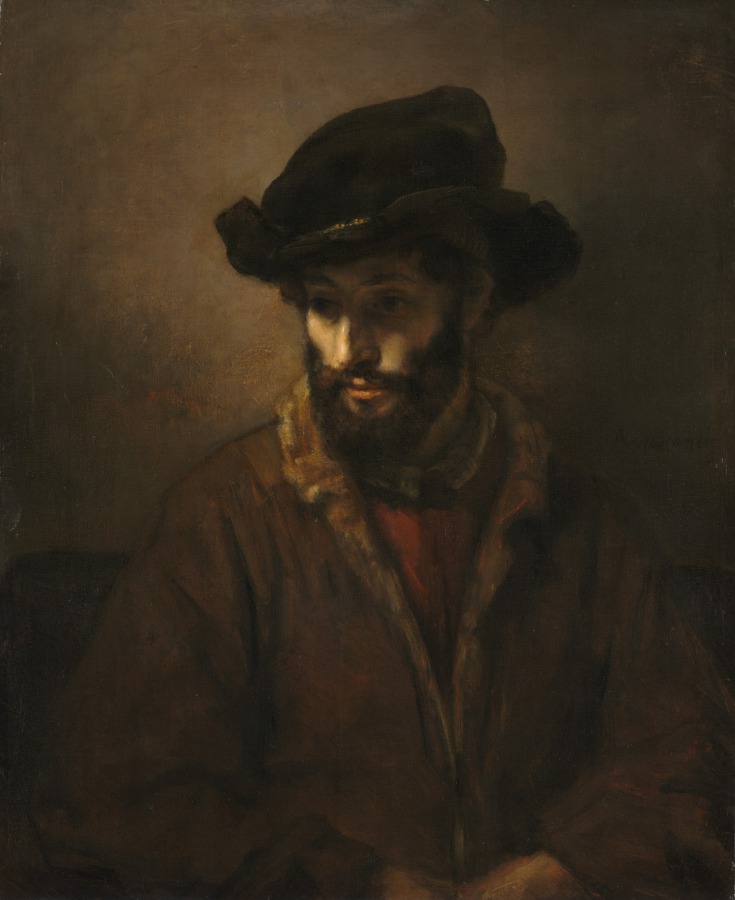
Life and career
Rembrandt developed from a young painter in Leiden into a major figure in Amsterdam’s art market. Portraits, biblical subjects, drawings and prints remained interconnected throughout his career. Later work often uses selective finish and concentrated light to give ordinary gestures considerable emotional weight, without making every picture a confession of personal misfortune.
Works across a career
Selected examples, not a complete catalogue. Read date ranges and attributions before inferring a career sequence.
- 01
c. 1629 or 1632
c. 1629 or 1632
A Young Man with a Chain
- Material / technique
- oil on wood
- Attribution / role
- Museum attribution
- Collection / source
- The Cleveland Museum of Art
Museum catalogue note
This painting is an example of a tronie, a Dutch word meaning “head” or “facial expression.” Tronies were not intended to be identifiable portraits, but artistic investigations of facial appearance and fanciful costume. Particularly in the years around 1630, Rembrandt used this popular format to explore different lighting effects and facial expressions. Here, the strong contrast of light and shade shapes the contours of the young man’s face; unusual accessories such as the striped scarf and glittering pendant on a jeweled chain add an exotic touch. Although this painting bears Rembrandt’s monogram, the authorship is not certain. Some scholars have attributed it to Isaac de Joudreville (1613–1648), a pupil and associate of Rembrandt who painted comparable tronies in a similarly smooth and elegant style.
Collection text · The Cleveland Museum of Art · CC0 - 02
1641
1641
Landscape with a Cottage and Hay Barn: Oblong
- Material / technique
- etching and drypoint
- Attribution / role
- Museum attribution
- Collection / source
- The Cleveland Museum of Art
- 03
c. 1662–65
c. 1662–65
The Meeting of Christ with Martha and Mary after the Death of Lazarus
- Material / technique
- reed pen and brown ink and wash, heightened with white gouache (in the heads of the kneeling figures)
- Attribution / role
- Museum attribution
- Collection / source
- The Cleveland Museum of Art
Museum catalogue note
Scholars now consider this drawing a rare, late work by Rembrandt. Here, Christ meets with Martha and Mary after the death of their brother, Lazarus (John 11:30–36). The composed dignity of Christ's face and his calm compassion contrast with the prostrate figure of Mary and the agitated drawing of the kneeling Martha, whose outstretched hands are repeated three times, suggesting a frenzied expressivity. Above Martha, white gouache obliterates the figure of a standing man as well as a first version of Martha's head. The combination of rough power and sublime tenderness that characterizes Rembrandt's late drawing style is here demonstrated in the dramatic rendering of the sisters' grief and the sensitive portrayal of the bearded old man who dries his eyes with a kerchief at the right.
Collection text · The Cleveland Museum of Art · CC0
Materials, marks and colour
Media and surface
Oil, drawing and intaglio printing develop related problems through different surfaces.
Marks and structure
Selective finish and concentrated gestures distinguish important forms from secondary detail.
Palette and light
Strong tonal organisation makes light an expressive focus; monochrome works retain rich spatial nuance.
Sources and further reading
Original educational interpretation; catalogue descriptions are separately credited. Each study links to its source. Reference entries without images are not added to the comparison timeline.