Life and career
Veronese built a career in sixteenth-century Venice, creating large religious and civic pictures as well as portraits. Architectural settings, sumptuous fabrics and choreographed figures often organise his narratives. Drawings reveal the planning behind these apparently effortless spectacles and provide a useful counterpoint to his finished paintings.
Works across a career
Selected examples, not a complete catalogue. Read date ranges and attributions before inferring a career sequence.
- 01
c. 1570
c. 1570
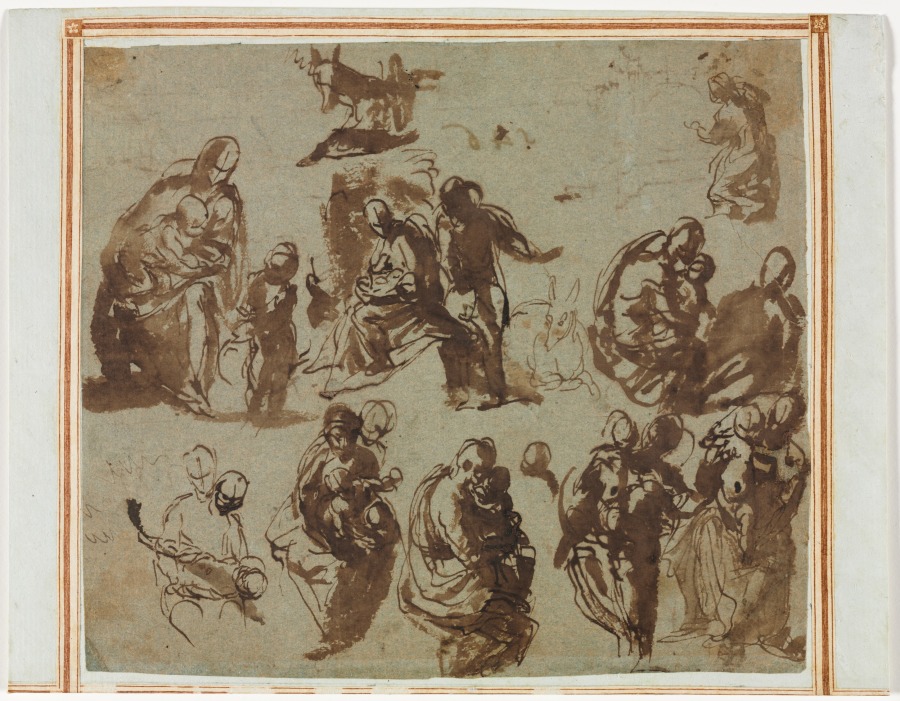
Various Sketches of the Madonna and Child (recto); Architectural Studies (verso) [partially visible on recto]
- Material / technique
- pen and brown ink (iron gall) and brush and brown wash
- Attribution / role
- Museum attribution
- Collection / source
- The Cleveland Museum of Art
Museum catalogue note
In the last decades of his career, Paolo Veronese and his workshop produced a number of idyllic visions of the Holy Family in repose in the countryside during their flight into Egypt. This crowded sheet of loose, lively sketches was recently proposed to have inaugurated an intensive period of interest in this subject that began around 1570. The sheet shows two horizontal rows with eight versions of the seated Virgin holding the Christ Child, in some of the sketches accompanied by the infant John the Baptist or Joseph, and in one by a donkey. The sheet presents an unusual case of being preparatory not for paintings, but for finished chiaroscuro drawings, now in London, Berlin, and Cambridge, MA. While the individual sketches may appear at first glance a mass of tangled lines and confused forms, such pen and ink drawings demonstrate the Venetian artist's restless creative energy.
Collection text · The Cleveland Museum of Art · CC0 - 02
after c. 1571
after c. 1571
Portrait of Agostino Barbarigo
- Material / technique
- oil on canvas
- Attribution / role
- Museum attribution
- Collection / source
- The Cleveland Museum of Art
Museum catalogue note
Barbarigo served as second in command of the Venetian naval forces during the Battle of Lepanto, fighting against the Ottoman Empire on October 7, 1571. During the skirmish, Barbarigo was slain by a Turkish arrow, which he holds in the portrait.Barbarigo’s identity is defined by his military prowess. In the 1500s, Venetian military portraits often portrayed the sitter in armor in a pose typical of a Roman emperor, creating a link to the valor and might of ancient armies.
Collection text · The Cleveland Museum of Art · CC0 - 03
c. 1580
c. 1580
The Annunciation
- Material / technique
- oil on canvas
- Attribution / role
- Museum attribution
- Collection / source
- The Cleveland Museum of Art
Museum catalogue note
Although Veronese is best known for his large-scale, pageant-like presentations, here the artist has taken the narrative of the Annunciation (the announcement of the angel Gabriel to the Virgin Mary that she would conceive and bear a son) and compressed the figures close to one another, creating a startling intimacy. According to a tradition established by the medieval writer Saint Bernard, Mary has been reading from the Old Testament prophecy of Isaiah (7:14), "A young woman is with child and she will bear a son."
Collection text · The Cleveland Museum of Art · CC0
Materials, marks and colour
Media and surface
Pen-and-wash studies test arrangements before colour and larger painted settings develop them.
Marks and structure
Architectural framing, staged gestures and elaborate drapery give narratives a ceremonial rhythm.
Palette and light
Rich fabrics and contrasting light organise oil paintings; monochrome studies isolate structural choices.
Sources and further reading
Original educational interpretation; catalogue descriptions are separately credited. Each study links to its source. Reference entries without images are not added to the comparison timeline.