Life and career
Origins and training
Pucelle worked in Paris in the early fourteenth century. Documents identify him, but do not give a reliable birthplace or account of his childhood training.
Places, turning points and artistic change
His small manuscript pictures combine Gothic figures with a growing interest in convincing rooms and gestures. The Belleville Breviary and the 1327 Bible name collaborators, reminding us that a manuscript was usually a workshop undertaking.
Beyond the studio
Book painting connected painters with scribes, patrons and devotional reading. Later Parisian illuminators developed his approach; we should distinguish documented work from later attributions.
Works across a career
Selected examples, not a complete catalogue. Read date ranges and attributions before inferring a career sequence.
Reading the selected works together
Compare three manuscript projects as related workshop productions, not as a fully documented early–middle–late biography.
- 01
c. 1323–26
c. 1323–26
Belleville Breviary
- Material / technique
- Illuminated manuscript
- Attribution / role
- See the museum attribution
- Collection / source
- IRHT / CNRS — Jean Pucelle and documented manuscripts
A collaborative project associated with Pucelle, Mahiet, Ancelet and Jean Chevrier.
- 02
c. 1324–28
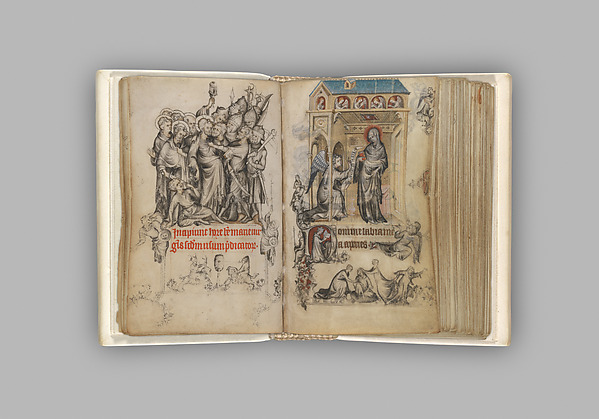 Explore artwork ↗
c. 1324–28
The Hours of Jeanne d’Evreux, Queen of France
- Material / technique
- Grisaille, tempera, and ink on vellum
- Attribution / role
- Collection / source
- The Metropolitan Museum of Art
Artist-wide context
He painted tiny book illustrations with expressive people and rooms that feel three-dimensional.
The Cloisters Collection, 1954 · Public Domain - 03
1327
1327
Bible copied by Robert de Billyng
- Material / technique
- Illuminated manuscript
- Attribution / role
- See the museum attribution
- Collection / source
- IRHT / CNRS — Jean Pucelle and documented manuscripts
Its production record helps identify painters and scribal collaboration.
Materials, marks and colour
Media and surface
Ink, tempera and vellum suit close reading at a small scale.
Marks and structure
Fine outlines and pale modelling make gestures legible without heavy paint.
Palette and light
Grisaille keeps much of the image restrained; small coloured details become especially noticeable.