Life and career
Origins and training
Yamamoto was born in Okazaki and moved to Tokyo as a child. Apprenticeship in a wood-engraving workshop gave him practical skills before his studies of Western-style painting.
Places, turning points and artistic change
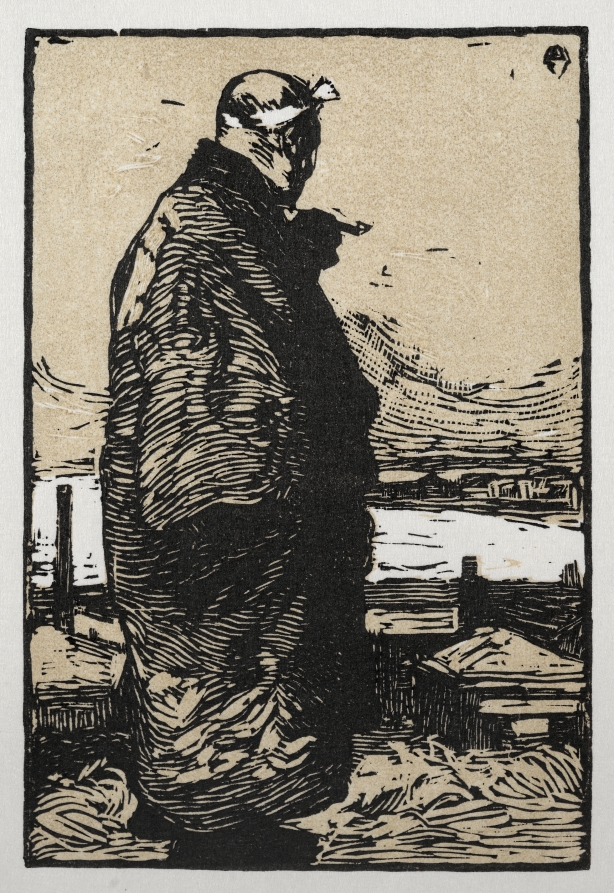
The Fisherman design of 1904 helped establish artist-led Japanese printmaking. Travel to France in 1912 and return through Russia in 1916 widened his thinking about art and society.
Beyond the studio
He promoted children’s free drawing and rural craft education. These educational movements were central achievements, not minor activities beside his prints.
Works across a career
Selected examples, not a complete catalogue. Read date ranges and attributions before inferring a career sequence.
Reading the selected works together
The fisherman, shipboard view and Moscow print connect local observation with travel. An impression’s printing date can differ from the design date.
- 01
1906
 Explore artwork ↗
- 02
1912
1912
A Corner of the Deck
- Material / technique
- Woodblock print
- Attribution / role
- See the museum attribution
- Collection / source
- Ueda City Museum — Yamamoto Kanae: life and works
Based on observation during his voyage to Europe.
- 03
1916
1916
Moscow
- Material / technique
- Woodblock print
- Attribution / role
- See the museum attribution
- Collection / source
- Ueda City Museum — Yamamoto Kanae: life and works
A travel image to place beside the earlier Japanese subject.
Materials, marks and colour
Media and surface
Carving and printing turn a drawn observation into a repeatable image.
Marks and structure
Visible knife marks can describe both a person and the light around them.
Palette and light
Black-and-white force and coloured printing offered different ways to simplify a view.