Life and career
Origins and training
Basawan, also called Basavana, worked in Akbar’s imperial painting workshop. His early life is not securely documented; manuscript credits provide stronger evidence than a complete childhood biography.
Places, turning points and artistic change
Early Tuti-nama pages were followed by major imperial book projects. Close observation of people and landscape, together with ideas encountered in European prints, helped develop more layered pictorial space.
Beyond the studio
His influence spread through a collaborative court workshop and through his son, the painter Manohar. Naming separate contributions matters when several artists designed and finished a manuscript page.
Works across a career
Selected examples, not a complete catalogue. Read date ranges and attributions before inferring a career sequence.
Reading the selected works together
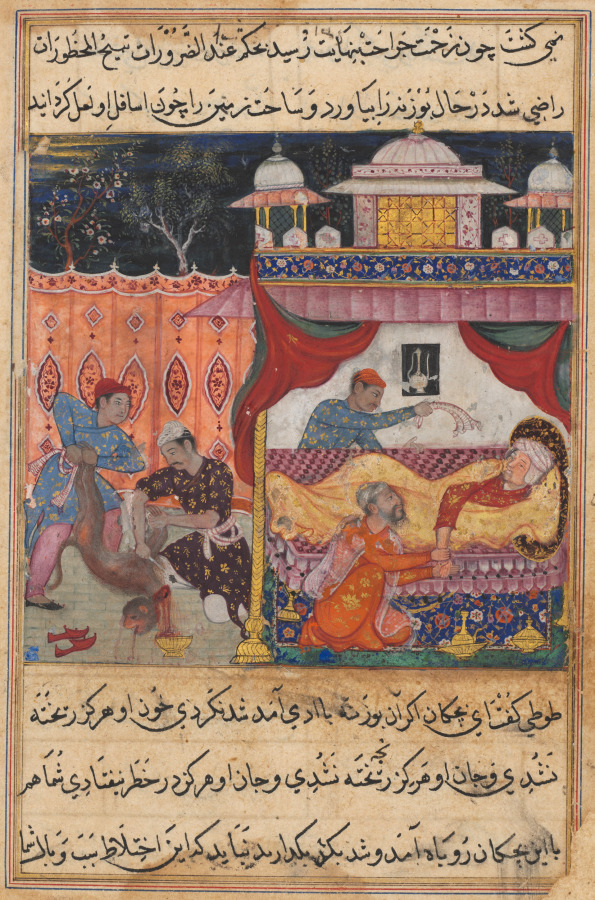
The narrative page, mendicant and walking ascetic show a range from crowded storytelling to close attention to one encounter or figure.
- 01
c. 1560
 Explore artwork ↗
c. 1560
The monkey slain, his blood to be used as medicine for the ailing prince he has bitten, from a Tuti-nama (Tales of a Parrot): Fifth Night
- Material / technique
- gum tempera, ink, and gold on paper
- Attribution / role
- Collection / source
- The Cleveland Museum of Art
Artist-wide context
He arranged many figures into readable stories, working within Akbar’s collaborative painting workshop.
· CC0 - 02
c. 1585; borders added later
c. 1585; borders added later
A Mendicant Bowing before a Holy Man
- Material / technique
- Gum tempera, ink and gold on paper
- Attribution / role
- See the museum attribution
- Collection / source
- Cleveland Museum of Art
Later borders belong to the object’s history, not necessarily the original painting campaign.
- 03
c. 1600
c. 1600
Jain Ascetic Walking Along a Riverbank
- Material / technique
- Gum tempera, ink and gold on paper
- Attribution / role
- See the museum attribution
- Collection / source
- Cleveland Museum of Art
A single figure offers another setting for close observation.
Materials, marks and colour
Media and surface
Fine brushes, ink, gum tempera and gold suit small, closely viewed pages.
Marks and structure
Gesture and overlapping landscape help organise crowded stories.
Palette and light
Careful colour distribution separates incidents without breaking the page into unrelated pieces.