Life and career
Origins and training
Mansur’s childhood and exact life dates are uncertain. Named credits place him in the Mughal court workshop, initially contributing to larger manuscript projects.
Places, turning points and artistic change
Under Jahangir he increasingly made individual studies of birds, animals and plants. Travel with the emperor and access to unusual animals supplied subjects, while book illumination remained another important skill.
Beyond the studio
His work records encounters with living creatures and the imperial collection of knowledge. It should be read as art, observation and courtly patronage together, rather than as modern zoological illustration alone.
Works across a career
Selected examples, not a complete catalogue. Read date ranges and attributions before inferring a career sequence.
Reading the selected works together
The hornbill, turkey and zebra are individual observations, not interchangeable symbols of a generic exotic animal.
- 01
c. 1612
c. 1612
Turkey Cock
- Material / technique
- Painting on paper
- Attribution / role
- See the museum attribution
- Collection / source
- Victoria and Albert Museum
A bird presented to Jahangir becomes an object of close visual study.
- 02
painting c. 1615–20
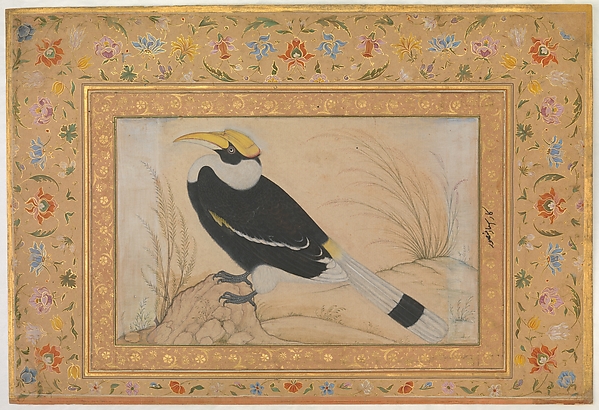 Explore artwork ↗
painting c. 1615–20
Great Hornbill, folio from the Shah Jahan Album
- Material / technique
- Ink, opaque watercolor, and gold on paper
- Attribution / role
- Collection / source
- The Metropolitan Museum of Art
Artist-wide context
Close attention to feathers, fur and plants helped record particular animals and natural specimens.
Purchase, Rogers Fund and The Kevorkian Foundation Gift, 1955 · Public Domain - 03
1621
1621
Zebra
- Material / technique
- Painting on paper
- Attribution / role
- See the museum attribution
- Collection / source
- Victoria and Albert Museum
The emperor’s inscription records the animal’s arrival and the painter’s name.
Materials, marks and colour
Media and surface
Fine brush lines and thin washes can describe feathers without losing the whole silhouette.
Marks and structure
A lightly indicated setting leaves attention on the animal’s particular posture.
Palette and light
Small colour changes and metallic details can distinguish species and surface qualities.