Life and career
Origins and training
Nainsukh came from the Guler family workshop of his father, painter Pandit Seu. His elder brother Manaku was also a painter.
Places, turning points and artistic change
Around 1740 he moved to Jasrota, where patron Balwant Singh became a frequent subject. Formal appearances and small daily incidents received equally careful observation, while Mughal painting offered useful models.
Beyond the studio
His approach influenced the next generation of family painters. Works by followers, workshop members and later descendants should be distinguished from works attributed to his own hand.
Works across a career
Selected examples, not a complete catalogue. Read date ranges and attributions before inferring a career sequence.
Reading the selected works together
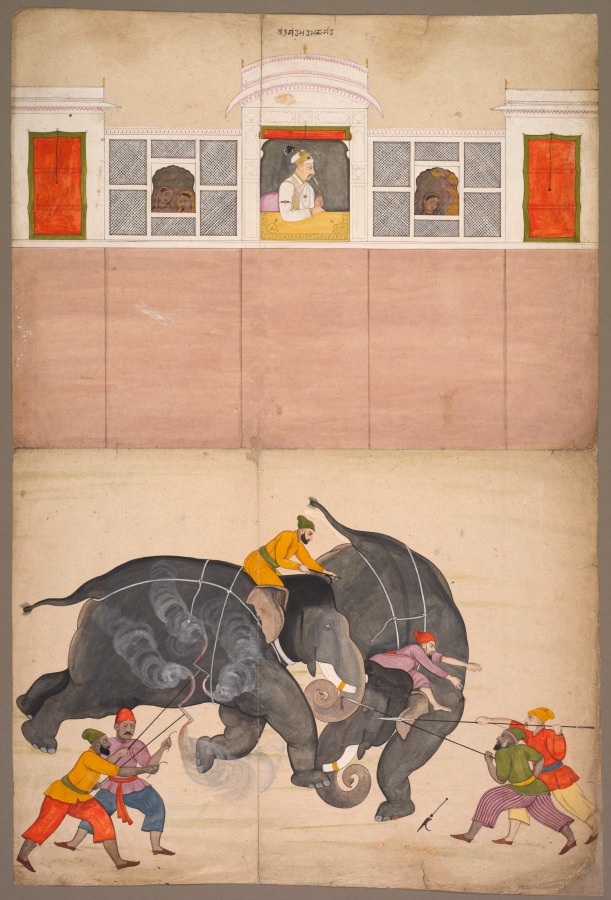
The elephant scene, devotional vision and quiet goose encounter show a wide range. All selected attributions should be read as the museums state them.
- 01
c. 1730–40
 Explore artwork ↗
c. 1730–40
Two Elephants Fighting in a Courtyard Before Muhammad Shah
- Material / technique
- Gum tempera, ink, and gold on paper
- Attribution / role
- attributed to
- Collection / source
- The Cleveland Museum of Art
Artist-wide context
In the Pahari courts, close observation made royal life feel unusually personal and everyday.
· CC0 - 02
c. 1745–50
c. 1745–50
Raja Balwant Singh’s Vision of Krishna and Radha
- Material / technique
- Ink, opaque watercolour and gold on paper
- Attribution / role
- Attributed to Nainsukh
- Collection / source
- The Metropolitan Museum of Art
Attributed to Nainsukh; devotion is staged within a carefully divided space.
- 03
c. 1763
c. 1763
Balwant Singh with a Goose
- Material / technique
- Brush drawing with light pigment on paper
- Attribution / role
- Attributed to Nainsukh
- Collection / source
- The Met / Howard Hodgkin Indian Collection Trust
Attributed to Nainsukh; the bird’s meaning remains an interpretation, not an established fact.
Materials, marks and colour
Media and surface
Fine brush drawing and light or opaque colour offer different degrees of finish.
Marks and structure
Subtle posture and the space around a figure can carry the emotional event.
Palette and light
Pale clothing and architecture can sharpen small bright accents and landscape greens.