Life and career
Origins and training
Nihal Chand is associated with the Kishangarh court and the patron Savant Singh. Surviving paintings provide stronger evidence than a detailed account of his childhood or training.
Places, turning points and artistic change
Idealised profiles and devotional lovers distinguish this court’s pictures. A signed boat scene records his name, while other famous images are attributed or belong to the wider school; those categories should not be merged.
Beyond the studio
His legacy connects court portraiture with poetry and devotion. An elegant face is not automatically a literal likeness, and a familiar modern attribution is not a substitute for the museum’s current record.
Works across a career
Selected examples, not a complete catalogue. Read date ranges and attributions before inferring a career sequence.
Reading the selected works together
The attributed royal portrait and signed boat scene are compared with a related Radha image. The third is context, not a claimed autograph work.
- 01
mid-1700s
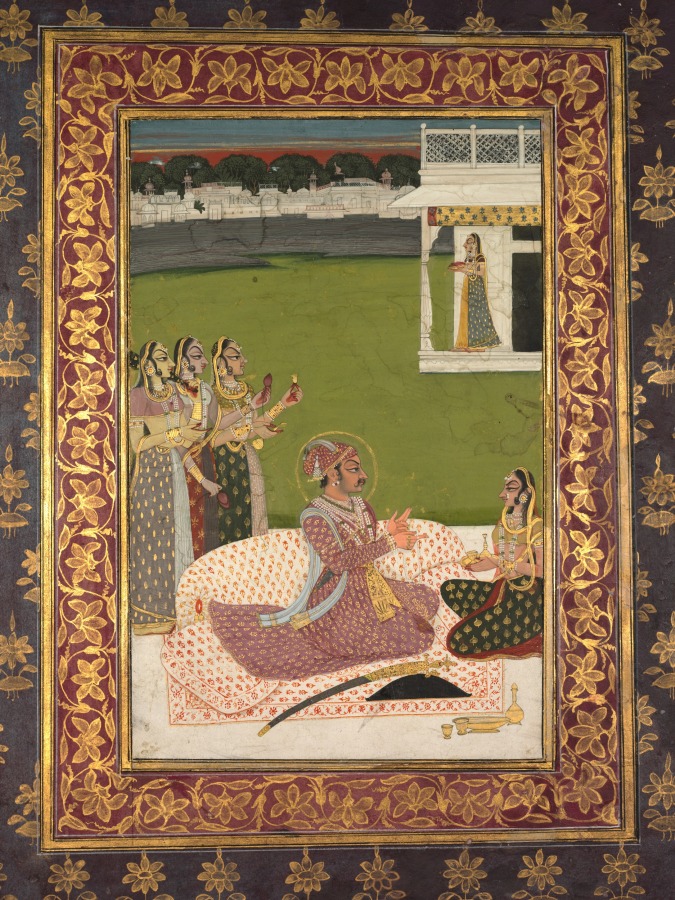 Explore artwork ↗
mid-1700s
Portrait of Maharaja Savant Singh with Consort, Bani Thani
- Material / technique
- Gum tempera, ink, and gold on paper
- Attribution / role
- attributed to
- Collection / source
- The Cleveland Museum of Art
Artist-wide context
Elegant, idealised figures became a distinctive part of painting at the Kishangarh court.
· CC0 - 02
c. 1750
c. 1750
Radha and Krishna in the Boat of Love
- Material / technique
- Natural colour on paper
- Attribution / role
- See the museum attribution
- Collection / source
- National Museum, New Delhi
The National Museum records Nihal Chand and an artist’s signature.
- 03
c. 1750
c. 1750
Radha, the Beloved of Krishna
- Material / technique
- Ink and opaque watercolour on paper
- Attribution / role
- Related school context · maker not recorded
- Collection / source
- The Metropolitan Museum of Art
Related Kishangarh context: the museum discusses Nihal Chand’s style, but does not name a maker in this object’s attribution.
Materials, marks and colour
Media and surface
Fine paper painting makes small changes of outline highly visible.
Marks and structure
Long eyes and carefully curved profiles can express a literary ideal of beauty.
Palette and light
Clear colour areas, pale architecture and landscape organise intimacy and distance.