 ↗
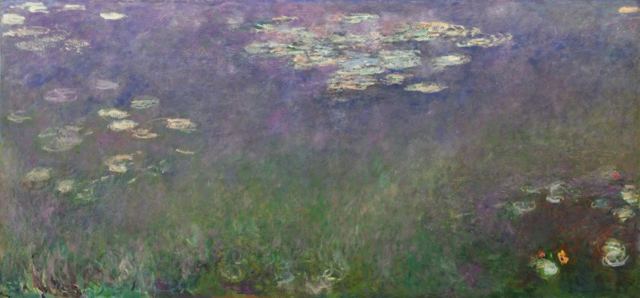
France, late 19th century-early 20th century · c. 1915–26
Water Lilies (Agapanthus)
Claude Monet
#22201B#000000#1A1815#393228#010000#000001Estimated from six colour groups in the museum image, including visible paper or borders. Reproduction and lighting affect the result; these are image-area proportions, not pigment measurements.
Bequest of John L. Severance · The Cleveland Museum of Art
Image licence: CC0 · Museum record & image source ↗
This painting is an example of a tronie, a Dutch word meaning “head” or “facial expression.” Tronies were not intended to be identifiable portraits, but artistic investigations of facial appearance and fanciful costume. Particularly in the years around 1630, Rembrandt used this popular format to explore different lighting effects and facial expressions. Here, the strong contrast of light and shade shapes the contours of the young man’s face; unusual accessories such as the striped scarf and glittering pendant on a jeweled chain add an exotic touch. Although this painting bears Rembrandt’s monogram, the authorship is not certain. Some scholars have attributed it to Isaac de Joudreville (1613–1648), a pupil and associate of Rembrandt who painted comparable tronies in a similarly smooth and elegant style.
Collection text · The Cleveland Museum of Art · CC0The youthful figure painting, 1641 etched landscape and late biblical drawing reveal different economies of means. Painted light models a body; printed lines organise a landscape; the drawing can concentrate a narrative in a few gestures. Compare tonal contrast and the amount of detail needed for recognition rather than assuming later work is merely less finished.
Artist-wide context; individual works may differ.
Oil, drawing and intaglio printing develop related problems through different surfaces.
Selective finish and concentrated gestures distinguish important forms from secondary detail.
Strong tonal organisation makes light an expressive focus; monochrome works retain rich spatial nuance.
Start with what you can see: shapes, surface, colour and scale. How might the listed materials affect the way this object was made and experienced?
Looking prompt · an invitation to observe, not a historical interpretation.