 ↗
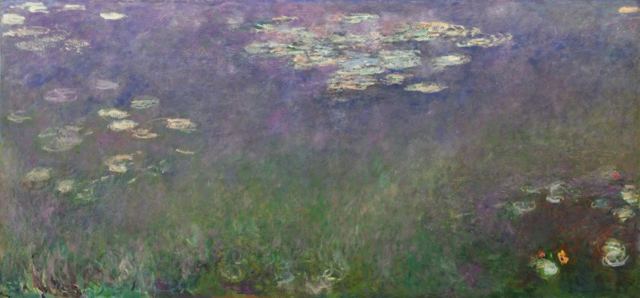
France, late 19th century-early 20th century · c. 1915–26
Water Lilies (Agapanthus)
Claude Monet
#2A3134#7A3A36#435D58#55372A#836B62#5B4C46Estimated from six colour groups in the museum image, including visible paper or borders. Reproduction and lighting affect the result; these are image-area proportions, not pigment measurements.
Gift of the Hanna Fund · The Cleveland Museum of Art
Image licence: CC0 · Museum record & image source ↗
Painted on a remote island in Polynesia a year before the artist's death, The Call belongs to a series of late works that explore the mysteries of life and death. Two women stand with bare feet, as if on sacred ground. One woman gestures to someone outside the picture, perhaps responding to a "call" from fate or destiny. Gauguin realized his ambition of painting from memory and the imagination through such mysterious, dreamlike images.
Collection text · The Cleveland Museum of Art · CC0The early chalk study relies on tonal drawing; the 1891 head and 1902 painting use different kinds of presence and narrative. Compare flat areas, outlines and the relationship between figures and setting. Colour can carry a symbolic mood without providing reliable evidence of the sitter’s inner life or an authentic, timeless culture.
Artist-wide context; individual works may differ.
Drawing, painting and printmaking offer parallel routes; material changes do not form a simple ladder.
Emphatic outlines and simplified planes reduce conventional modelling and strengthen symbolic arrangement.
Non-naturalistic colour creates mood; the palette must be read within the work’s colonial and imaginative context.
Start with what you can see: shapes, surface, colour and scale. How might the listed materials affect the way this object was made and experienced?
Looking prompt · an invitation to observe, not a historical interpretation.