 ↗
France, late 19th century-early 20th century · c. 1915–26
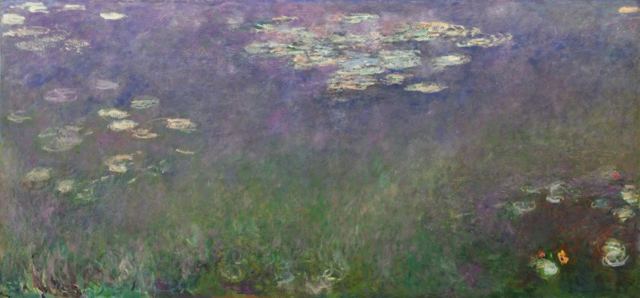
Water Lilies (Agapanthus)
Claude Monet
Leonard C. Hanna Jr. Fund · The Cleveland Museum of Art
Image licence: CC0 · Museum record & image source ↗
This sculpture, along with that of Saint Lawrence (1959.42) and two others in Germany, are believed to be the remaining fragments of a large altarpiece carved by Riemenschneider for the Dominican convent in Rothenburg in Franconia (demolished in 1813). Saints Stephen and Lawrence both wear the dalmatic to indicate their status as deacons in the early church. Each holds a symbol of his martyrdom; here, Saint Stephen cradles some stones to indicate his death by stoning. Art in Germany through the early 1500s remained firmly anchored in the late Gothic style with its associated interests in realism. Riemenschneider was one of the most prolific and versatile sculptors of this style, a recognized master in both stone and wood. His flourishing workshop employed as many as 40 apprentices in sculpting, woodcarving, and painting. His sculptures are noted for the dreamy, melancholy, and introspective quality in their expressions, as well as their remarkable attention to detail.
Collection text · The Cleveland Museum of Art · CC0Compare the earlier alabaster Saint Jerome with Saint Lawrence and Saint Stephen, both dated 1502–8. Follow carved folds, gestures and the relationship between pale stone, carved wood, surviving colour and gilding. The latter pair belongs to a shared commission context, not separate late-career phases. Present-day surface colour cannot by itself establish the original appearance.
Artist-wide context; individual works may differ.
Carved alabaster and wood retain different textures; colour and gilding also belong to object history.
Carved folds and restrained facial or hand gestures animate otherwise compact devotional figures.
Pale stone, surviving polychromy and gilding must be distinguished from later loss or surface alteration.
Start with what you can see: shapes, surface, colour and scale. How might the listed materials affect the way this object was made and experienced?
Looking prompt · an invitation to observe, not a historical interpretation.