 ↗
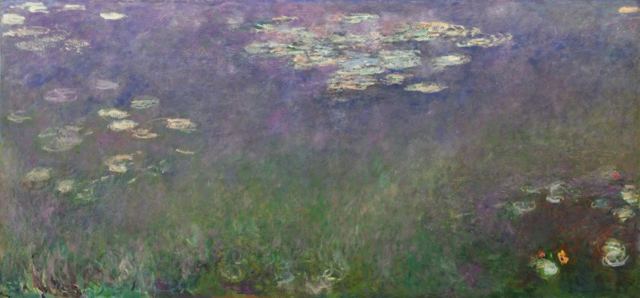
France, late 19th century-early 20th century · c. 1915–26
Water Lilies (Agapanthus)
Claude Monet
Gift of Louise S. Richards in honor of William Mathewson Milliken on his 85th year · The Cleveland Museum of Art
Image licence: CC0 · Museum record & image source ↗
Ernst Ludwig Kirchner made this print during the first year that he learned the lithographic process. In contrast to convention, he wished to make it immediately apparent that a lithograph was not a drawing. To do so, he used lithographic wash to draw right to the edges of the stone, abruptly cutting off the composition and emphasizing the stone’s irregular contour with inked edges. The spontaneity of the quickly drawn marks that mimic the weather and wind of the sea, coupled with the emphasis on the materiality of the stone, matched Kirchner’s quest for truth in his art.
Collection text · The Cleveland Museum of Art · CC0The 1908 sea lithograph, the street image around 1914 and the 1924 portrait use different print processes and kinds of compression. Compare broken tonal texture with cut relief edges, and how figures or landscape become angular rhythms. Monochrome can be as forcefully expressive as the bright colours of his paintings.
Artist-wide context; individual works may differ.
Lithography and woodcut produce different textures within an expressive graphic practice.
Angular bodies, compressed spaces and forceful cuts make familiar subjects feel unstable.
Black-white contrast can be as expressive as saturated painted colour; the selected prints demonstrate this directly.
Start with what you can see: shapes, surface, colour and scale. How might the listed materials affect the way this object was made and experienced?
Looking prompt · an invitation to observe, not a historical interpretation.