 ↗
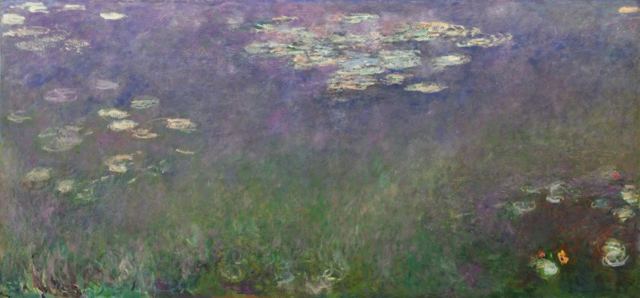
France, late 19th century-early 20th century · c. 1915–26
Water Lilies (Agapanthus)
Claude Monet
Delia E. Holden and L. E. Holden Funds · The Cleveland Museum of Art
Image licence: CC0 · Museum record & image source ↗
A very early etching by the Impressionist artist Camille Pissarro, this view of the massive rocks at La Roche-Guyon reveals the artist’s painterly attitude toward printmaking. Using only the etched line and a layer of ink left on his printing plate's surface, Pissarro created a dramatic landscape filled with brilliant sunlight and soft shadows.
Collection text · The Cleveland Museum of Art · CC0Follow the 1866 landscape, the 1872 lock, the 1879 woodland edge and the 1902 market. Compare the balance between architecture, foliage and human activity, then the changing density of marks. These selected works do not cover every colour experiment, so they should not be used to claim a continuous, one-direction shift in technique.
Artist-wide context; individual works may differ.
Painted landscapes and printed urban scenes preserve an interest in everyday environments.
Small repeated marks organise foliage, architecture and human activity without erasing their differences.
Tonal and colour relations bind land and sky; his divided-colour experiments were one phase, not a permanent rule.
Start with what you can see: shapes, surface, colour and scale. How might the listed materials affect the way this object was made and experienced?
Looking prompt · an invitation to observe, not a historical interpretation.