 ↗
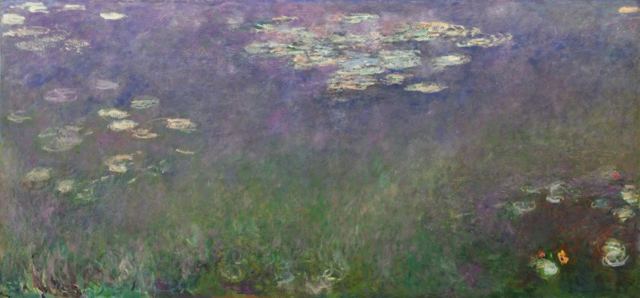
France, late 19th century-early 20th century · c. 1915–26
Water Lilies (Agapanthus)
Claude Monet
#D6D1C7#39433B#5D6959#455844#E2DED4#A6A899Estimated from six colour groups in the museum image, including visible paper or borders. Reproduction and lighting affect the result; these are image-area proportions, not pigment measurements.
Bequest of Leonard C. Hanna Jr. · The Cleveland Museum of Art
Image licence: CC0 · Museum record & image source ↗
In September 1883 Van Gogh left the bustling Dutch city of The Hague in search of open countryside in which to paint. He moved to Drenthe, a village in northeastern Netherlands that was virtually untouched by the Industrial Revolution. He described the barren terrain as supremely beautiful and serene: "What tranquility, what expanse, what calmness in this nature." With a limited palette of steely greens and cool blues, Van Gogh masterfully portrayed one of the region’s expanses of heath—"a vast plane vanishing into infinity"—illuminated by the lilac hues of the evening sky.
Collection text · The Cleveland Museum of Art · CC0The 1883 watercolour and chalk landscape uses earthy tonal structure; the 1889 oil landscape activates the surface through colour and directional marks. In Dr. Gachet, etched and drypoint lines replace painted colour. This final print shows that late experimentation did not mean abandoning drawing or moving inevitably toward brighter paint.
Artist-wide context; individual works may differ.
Watercolour, oil and the rare etched plate produce distinct surfaces across the selected career.
Directional, rhythmic marks make plants, sky and ground feel active; print lines condense this energy.
Earthy early tones contrast with intensified later colour, while the final etching remains powerfully monochrome.
Start with what you can see: shapes, surface, colour and scale. How might the listed materials affect the way this object was made and experienced?
Looking prompt · an invitation to observe, not a historical interpretation.