 ↗
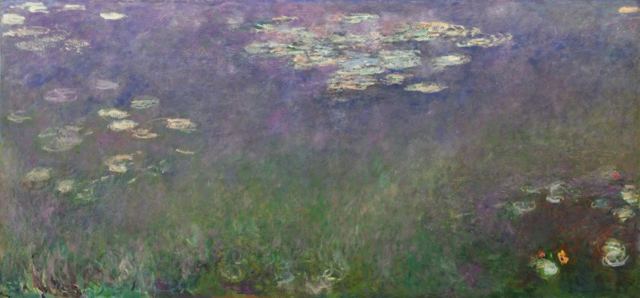
France, late 19th century-early 20th century · c. 1915–26
Water Lilies (Agapanthus)
Claude Monet
#474940#3C3D38#40413B#353533#585950#B4B1A8Estimated from six colour groups in the museum image, including visible paper or borders. Reproduction and lighting affect the result; these are image-area proportions, not pigment measurements.
Anonymous Gift · The Cleveland Museum of Art
Image licence: CC0 · Museum record & image source ↗
In 1886, Winslow Homer began to produce oil paintings and watercolors of subjects in the Adirondack Mountains, where he and his brother Charles had fished and hunted since the 1870s. In Leaping Trout, a silvery trout propels itself from the water in pursuit of a hapless insect or a fisherman’s fly. Homer’s choice to adopt the fish’s perspective, rather than a fisherman’s, is quite unconventional and heightens the drama and immediacy of the scene. His technique, influenced by the free brushwork of French Impressionism, similarly animates his still-life subject. Luminous washes of transparent blue and grey watercolor suggest the fish’s iridescent skin, while opaque pricks of bright red on its body lend a decorative effect reminiscent of Japanese prints. On the water’s surface, Homer uses scraping to create two brilliant white highlights, and dry brushing to produce the impression of a reflective surface. Although the overall effect is mysterious and dreamlike, the color and movement of the fish is carefully studied, suggesting Homer’s desire to appeal to the sportsmen who might buy his works.
Collection text · The Cleveland Museum of Art · CC0The 1864 oil painting builds a human narrative; Leaping Trout exploits watercolour’s transparent washes and rapid accents; the late marine oil makes surf and rock monumental. Compare how the support’s light participates in watercolour, while layered oil can create a denser, more physically resistant surface.
Artist-wide context; individual works may differ.
Oil builds dense surfaces while watercolour uses transparent washes, reserved paper and sharper accents.
Clear masses and forceful diagonals organise people, animals, surf and rock.
Cool water and darker landforms gain force through contrast rather than uniformly high saturation.
Start with what you can see: shapes, surface, colour and scale. How might the listed materials affect the way this object was made and experienced?
Looking prompt · an invitation to observe, not a historical interpretation.