 ↗
France, late 19th century-early 20th century · c. 1915–26
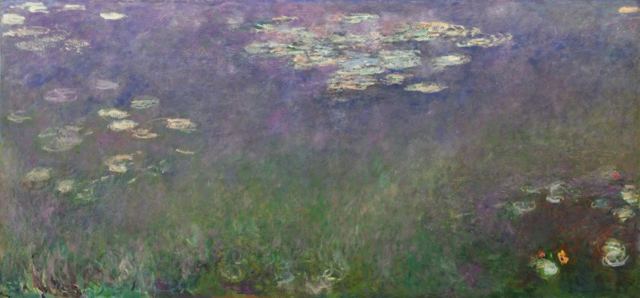
Water Lilies (Agapanthus)
Claude Monet
#3F5260#C39897#A6B4B0#969BA3#8D7A81#C1BCA6Estimated from six colour groups in the museum image, including visible paper or borders. Reproduction and lighting affect the result; these are image-area proportions, not pigment measurements.
Small, vivid details detected in the image. These areas are already included in the dominant groups above; their percentages are not added to the total.
#C2884F≈ 1.51%#587936≈ 0.18%Nancy F. and Joseph P. Keithley Collection Gift · The Cleveland Museum of Art
Image licence: CC0 · Museum record & image source ↗
Due to his diagnosis of persistent rheumatism, Henri-Edmond Cross left Paris in 1891 and settled in the seaside village of Saint-Clair on the Mediterranean coast where the climate was more temperate. He expressed his enthusiasm for the French Riveria to his mother, “In the distance, the blue silhouette of the Maures and the Estérel—I have enough here to keep me busy all of life—I have just discovered happiness.” Once he had settled in the south, Cross adopted the Neo-Impressionist technique of Pointillism—applying paint in small dots or dashes of complementary colors that mix in the beholder’s eye to create an intense sensation of color and light. Here, a spectacular cloud is illuminated by the sunset. A pair of cypress trees link the garden landscape below to the vivid sky above.
Collection text · The Cleveland Museum of Art · CC0Compare the mid-1890s cloud, the 1897 colour lithograph and the oil river scene around 1900. Printed colour and painted colour build light through different processes. Look at the size and spacing of marks and the relation between tree silhouettes, water and sky; the examples represent mature experiments rather than his earliest training.
Artist-wide context; individual works may differ.
Colour lithographs and oils use different processes to organise divided or separated marks.
Mosaic-like touches and broadening marks turn landscape into rhythmic surfaces.
Contrasting colour units generate luminosity, often emphasising harmony over naturalistic local colour.
Start with what you can see: shapes, surface, colour and scale. How might the listed materials affect the way this object was made and experienced?
Looking prompt · an invitation to observe, not a historical interpretation.