 ↗
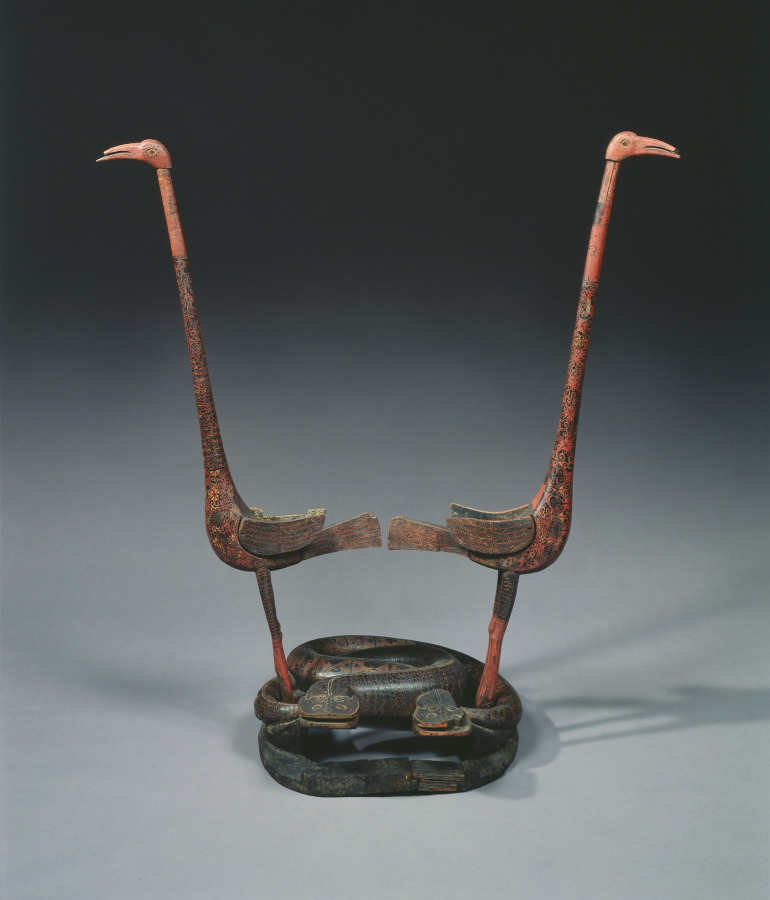
China, reportedly from Hunan province, Changsha, Warring States period (475–221 BCE), State of Chu (c. 1046–223 BCE) · 475–221 BCE
Cranes and Serpents
Creator not recorded
Gift of Severance A. Millikin · The Cleveland Museum of Art
Image licence: CC0 · Image policy · Museum record & image source ↗
Creator not recorded by the museum
Above the shoulders, connected drill holes give evidence of suspension. A maker had to position those openings so that this four-horned figure would hang in a particular attitude.
At amulet scale a bovine head must be legible with very few projections. Test which part remains identifiable when the whole form is reduced to a silhouette.
Site interpretation and practical exercises. Historical and technical evidence is linked below.
Sources for context The Cleveland Museum of Art ↗
Read alongside
With a bovine head and four horns, this seated figurine was a powerful ritual and shamanic symbol. Drill holes above its shoulders form two interconnected perforations for suspension, suggesting that the jade was originally used as a pendant, presumably by the shaman performing the tasks of journeying to and communicating with the supernatural realms.
Collection text · The Cleveland Museum of Art · CC0↗Creator not recorded
 ↗
Creator not recorded
 ↗
Creator not recorded
 ↗
Creator not recorded