 ↗
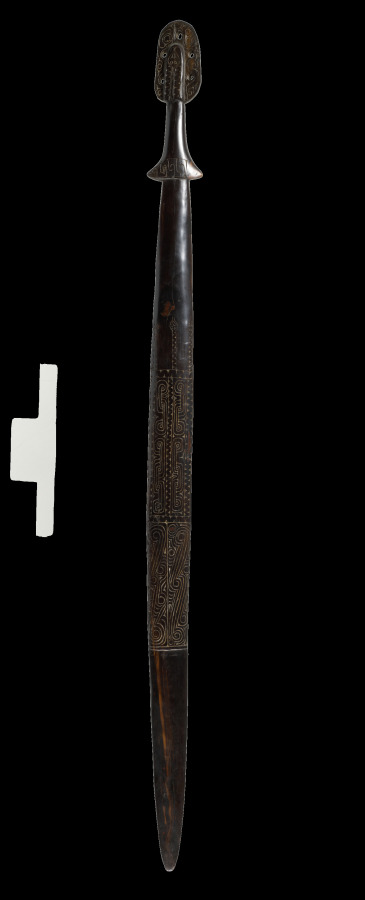
Melanesia, New Guinea, Massim Area, Trobriand Islands, 20th century · before 1930
Club
Creator not recorded
John L. Severance Fund · The Cleveland Museum of Art
Image licence: CC0 · Image policy · Museum record & image source ↗
Creator not recorded by the museum
The museum identifies this Fijian club by its unusual paddle-like shape and fine chip-carved patterning. The outline has a job at a distance; the small cuts become legible much closer. These scales can coexist. Enlarging a photograph brings the decoration forward, but can make us forget the relationship between the broad end and the narrower grip.
The catalogue dates the work broadly to the eighteenth or nineteenth century and identifies wood as its material. It does not establish a named maker or the specific circumstances in which this example was used. Its patterned surface alone cannot settle whether a particular occasion was ceremonial or practical. Form, documented identification and unknown history should remain separate.
Draw a broad shape joined to a narrow one. Put a dense pattern in one area and leave the other quiet; then reverse them. Compare how the visual balance changes while the outline stays fixed. This tests the relationship between pattern and structure, without copying a cultural motif and assigning it a meaning the record has not supplied.
Site interpretation and practical exercises. Historical and technical evidence is linked below.
Sources for context Cleveland — Club ↗
Section sources checked 2026-11-22
Read alongside
Fijian weapons are made of heavy, dense wood, ornamented with fine, chip-carved patterning. The paddle-like shape of this example is quite rare.
Collection text · The Cleveland Museum of Art · CC0↗Creator not recorded
 ↗
Creator not recorded
 ↗
Creator not recorded
 ↗
Creator not recorded