 ↗
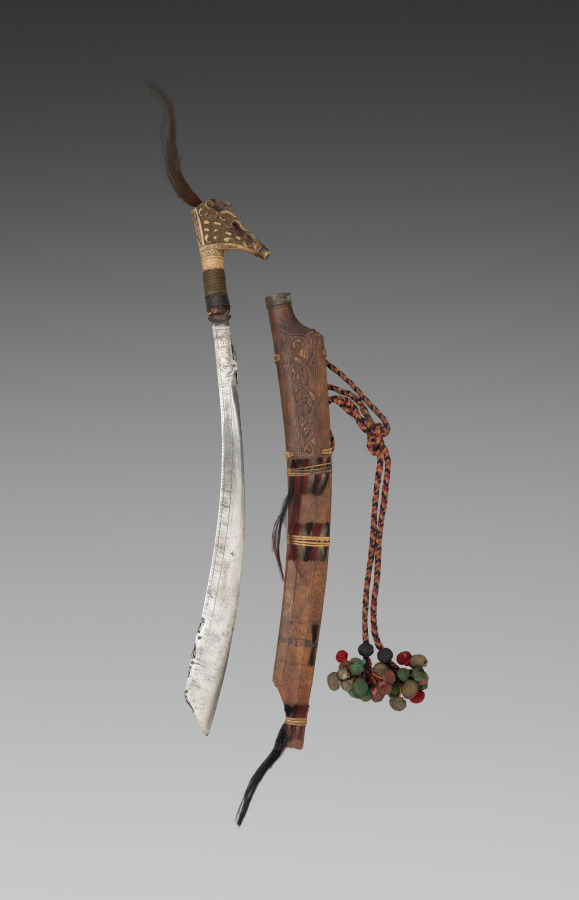
Indonesia, Borneo · c. 1900
Knife (Mandau) and scabbard
Creator not recorded
Gift of The Textile Arts Club · The Cleveland Museum of Art
Image licence: CC0 · Image policy · Museum record & image source ↗
Creator not recorded by the museum
These textiles played a ceremonial role in southern Sumatra. A vessel pictured on cloth could gather people and signs together in a way a practical drawing of a ship never needed to do.
In a ship cloth the vessel can organise figures and motifs into levels. Try tracing its hull before reading the textile as a field of repeats.
Site interpretation and practical exercises. Historical and technical evidence is linked below.
Sources for context The Cleveland Museum of Art ↗
Read alongside
For several hundred years, until early in the present century, textiles of this type played an essential, symbolic role in virtually every southern Sumatran ritual. Since there is no written mythological literature in Indonesia, the exact meaning of the "tampan pasisir" (as this ritual cloth is called) remains unknown. Nevertheless, this fine weaving must be a kind of narrative. Ships, of course, were essential to the life of these island people, and using one as an image for safe passage from one of life's stages to another seems plausible. This rare piece--few textiles of its age and condition from the tropical climes of Indonesia survive--was a most welcome gift to The Cleveland Museum of Art from the Textile Arts Club in honor of its 50th anniversary.
Collection text · The Cleveland Museum of Art · CC0↗Creator not recorded
 ↗
Creator not recorded
 ↗
Creator not recorded
 ↗
Creator not recorded