 ↗
China, Ming dynasty (1368–1644) · after 1490
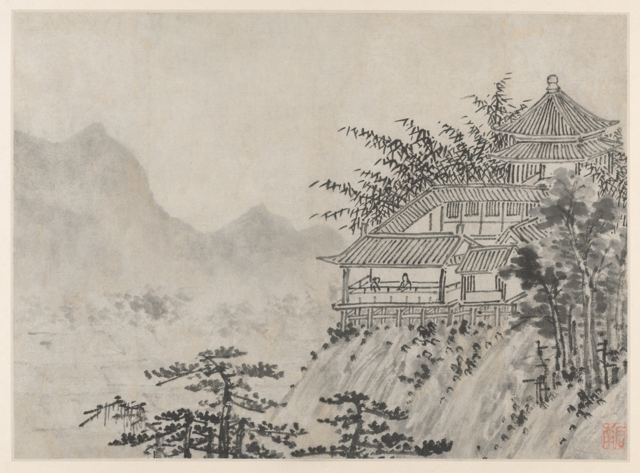
The Thousand Acres of Clouds, from Twelve Views of Tiger Hill, Suzhou
Shen Zhou
#847252#7B684A#7D6D50#665944#6F6650#A18C6BEstimated from six colour groups in the museum image, including visible paper or borders. Reproduction and lighting affect the result; these are image-area proportions, not pigment measurements.
Gift of Herbert F. Leisy in memory of his wife, Helen Stamp Leisy · The Cleveland Museum of Art
Image licence: CC0 · Image policy · Museum record & image source ↗
The qin here recalls Ji Kang, the third-century musician. That historical reference gives a later painted act of listening an imagined depth in time.
Look at who listens as well as who plays. A still body turned towards the qin can make sound present on a silent sheet.
Site interpretation and practical exercises. Historical and technical evidence is linked below.
Sources for context The Cleveland Museum of Art ↗
Read alongside
The painting alludes to a legendary incident from the life of Ji Kang 嵇康 (AD 223–262), a guqin player who belonged to a group of 3rd-century eccentric intellectuals. Ji Kang is known as the author of a Guangling San (廣陵散; Melody from Guangling), a composition for the guqin so haunting that it aroused spirits to visit him. The painting depicts the moment when one of the spirits––disguised as a human––is helped by another to emerge from the ground, while others are drawn to the musician playing in his cottage under the full moon.
Collection text · The Cleveland Museum of Art · CC0↗Shen Zhou
 ↗
Shitao
 ↗
Wen Zhengming
 ↗
Tang Yin