 ↗
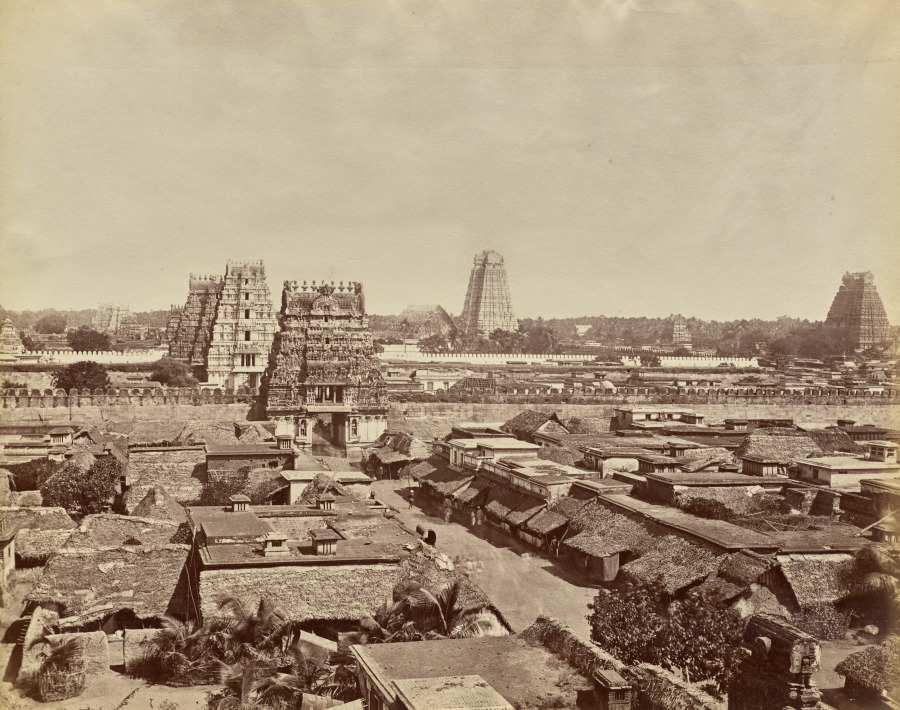
India · 1878
View from the Top of the Rock, looking over the native Town, Trichinopoly, India
Nicholas & Co.
#3A412F#635A3E#424330#A88851#2A2D2C#C5B397Estimated from six colour groups in the museum image, including visible paper or borders. Reproduction and lighting affect the result; these are image-area proportions, not pigment measurements.
Gift in honor of Madeline Neves Clapp; Gift of Mrs. Henry White Cannon by exchange; Bequest of Louise T. Cooper; Leonard C. Hanna Jr. Fund; From the Catherine and Ralph Benkaim Collection · The Cleveland Museum of Art
Image licence: CC0 · Image policy · Museum record & image source ↗
Creator not recorded by the museum
Nur Jahan holds a portrait, so the viewer meets two people at two scales. Trace the route from her hands into the smaller image to see how the emperor is made present in absence.
Site interpretation and practical exercises. Historical and technical evidence is linked below.
Sources for context The Cleveland Museum of Art ↗
Read alongside
A woman identified as the favorite wife of the Mughal emperor Jahangir (reigned 1605–27) holds a formal portrait of her husband. He appears aged with graying facial hair behind the jharokha carpet that marks imperial presence. This painting may be modeled on a work depicting Jahangir holding a portrait of his deceased father, showing himself to be the legitimate successor. Nur Jahan, who handled most of the affairs of state, hoped to remain in power after his death. She is depicted in her idealized youth, since she would have been 50 years old when Jahangir died.
Collection text · The Cleveland Museum of Art · CC0↗Nicholas & Co.
 ↗
Creator not recorded
 ↗
Bourne & Shepherd
 ↗
Creator not recorded