 ↗
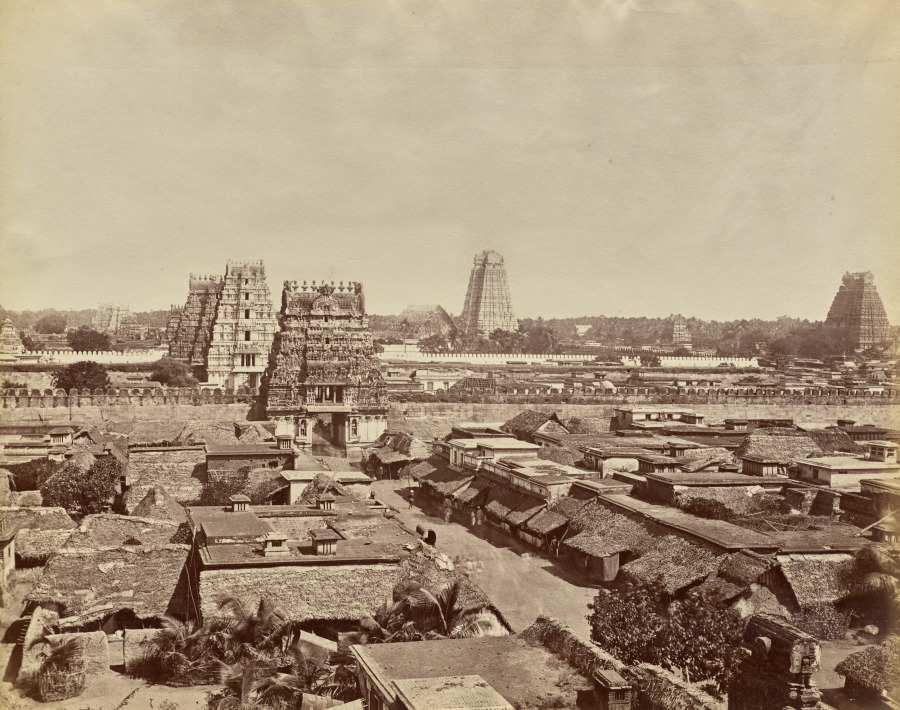
India · 1878
View from the Top of the Rock, looking over the native Town, Trichinopoly, India
Nicholas & Co.
Purchase from the J. H. Wade Fund · The Cleveland Museum of Art
Image licence: CC0 · Image policy · Museum record & image source ↗
Bourne & Shepherd
Ranbir Singh appears with members of the Dogra court. Ask how a viewer would pick him out if all the faces were reduced to dots; royal presence is partly an arrangement of other people.
A family and a court share this portrait. Trace who sits or stands near the ruler before comparing individual faces; distance can make rank visible.
Site interpretation and practical exercises. Historical and technical evidence is linked below.
Sources for context The Cleveland Museum of Art ↗
Read alongside
Ranbir Singh (1830–1885), a ruler of the military Dogra dynasty, sits enthroned, surrounded by members of his court. He was the son of Gulab Singh (reigned 1846–1856), depicted in the portrait at the left. The courtiers in the front row—including his son—sit in European-style chairs, and one of his soldiers wears a British-style uniform and helmet. The picture’s oval format was popular among the British. These visual elements communicate Dogra’s allegiance to British colonial rule. Ranbir Singh supported the British during the Uprising of 1857, after which India became part of the British Empire.
Collection text · The Cleveland Museum of Art · CC0↗Nicholas & Co.
 ↗
Creator not recorded
 ↗
Creator not recorded
 ↗
Creator not recorded