 ↗
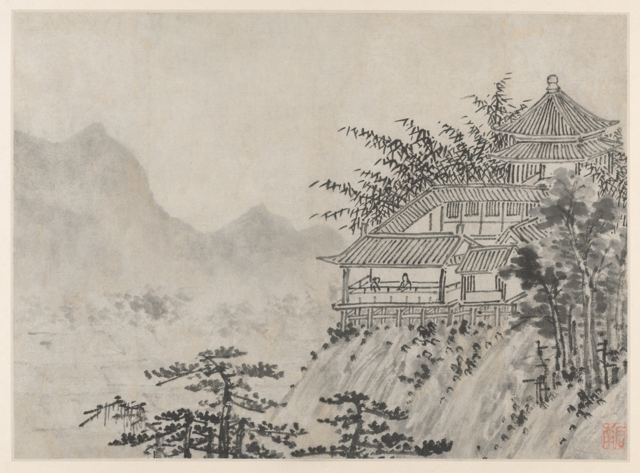
China, Ming dynasty (1368–1644) · after 1490
The Thousand Acres of Clouds, from Twelve Views of Tiger Hill, Suzhou
Shen Zhou
#D0BA99#979885#A59C86#8C8573#BFAE92#E0D3BDEstimated from six colour groups in the museum image, including visible paper or borders. Reproduction and lighting affect the result; these are image-area proportions, not pigment measurements.
Gift of the John Huntington Art and Polytechnic Trust · The Cleveland Museum of Art
Image licence: CC0 · Image policy · Museum record & image source ↗
Creator not recorded by the museum
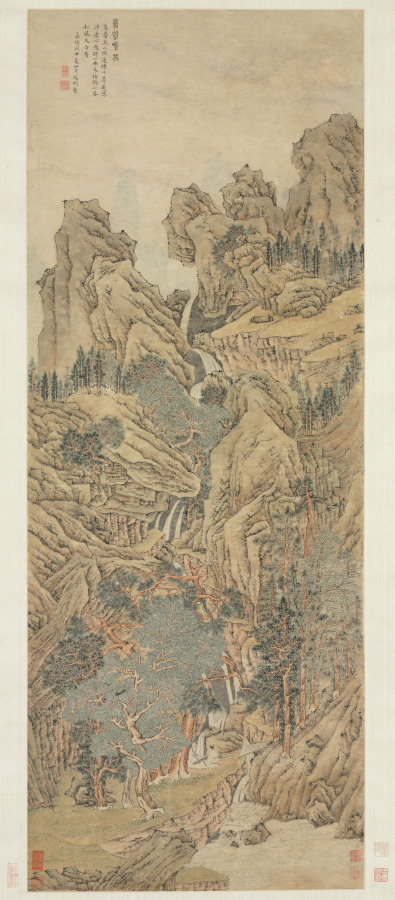
The museum describes this hanging scroll as a true-view landscape: painting concerned with actual places and observed terrain. That does not make it a neutral map. A tall picture has to arrange water, buildings and mountain forms so that the eye can move between them. The spaces between solid forms matter as much as the peaks themselves.
Cleveland places the work in late eighteenth- or early nineteenth-century Korea and connects it with a growing interest in topographic landscape. Here topographic means attentive to the shape of a place. The cited record does not identify a precise site or painter. It therefore supports a discussion of the tradition, not a confident biography or a claim that every bend reproduces a surveyed location.
Trace one route along water and another along the mountain edges. Water gives you continuity; ridges divide the land into masses. In your own landscape, decide which route should lead and simplify the competing one. The lesson is about organising attention, not copying a formula for all Korean painting.
Site interpretation and practical exercises. Historical and technical evidence is linked below.
Sources for context Cleveland — Landscape with Streams and Mountains ↗
Section sources checked 2026-11-22
Read alongside
The tradition of landscape painting that details actual natural sites and captures their topographic features in Korea began in the 1700s and continued onward. Such landscape style based actual sites and the artist's observation is called True-view landscape painting.
Collection text · The Cleveland Museum of Art · CC0↗Shen Zhou
 ↗
Shitao
 ↗
Wen Zhengming
 ↗
Tang Yin