 ↗
China, Ming dynasty (1368–1644) · after 1490
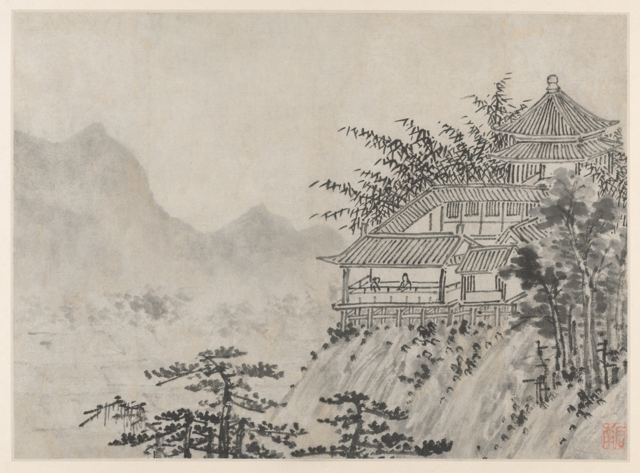
The Thousand Acres of Clouds, from Twelve Views of Tiger Hill, Suzhou
Shen Zhou
#534B3D#A7845B#8F7352#B68E61#9B7954#C29868Estimated from six colour groups in the museum image, including visible paper or borders. Reproduction and lighting affect the result; these are image-area proportions, not pigment measurements.
Mr. and Mrs. William H. Marlatt Fund · The Cleveland Museum of Art
Image licence: CC0 · Image policy · Museum record & image source ↗
Creator not recorded by the museum
This is a ten-panel screen seen from a bird's-eye viewpoint. Walking beside its real folds and imagining a journey through its pictured peaks are two different ways of travelling.
A named mountain can organise a scene as a destination. Trace the most plausible route to it, then the route your eye actually follows; these may diverge.
Site interpretation and practical exercises. Historical and technical evidence is linked below.
Sources for context The Cleveland Museum of Art ↗
Read alongside
With a bird’s-eye view, this ten-panel folding screen portrays the famous Seven Jeweled Mountain 칠보산 in North Korea. Ancient volcanic eruptions shaped the mountain’s unique and awe-inspiring terrain such as phallic-shaped pillars (panel #5, from the right); a large flat-topped, steep-sided cliff (panels #7 and #8), and a rugged mountain composed of metamorphic and igneous rocks (panels #9 and #10). The tradition of landscape painting that details actual natural sites and captures their topographic features in Korea began in the 1700s and continued onward. While such natural wonders were beloved as popular destinations for tourism and pilgrimage, after the Korean War (1950–53), these sites in North Korea are no longer accessible to the outside world. This folding screen detailing the mountain’s distinctive topography feeds our imagination and longing for such an unattainable place.
Collection text · The Cleveland Museum of Art · CC0↗Shen Zhou
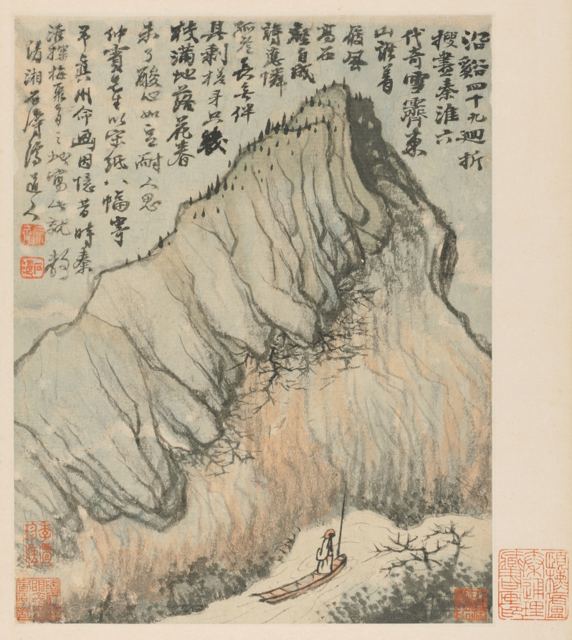 ↗
Shitao
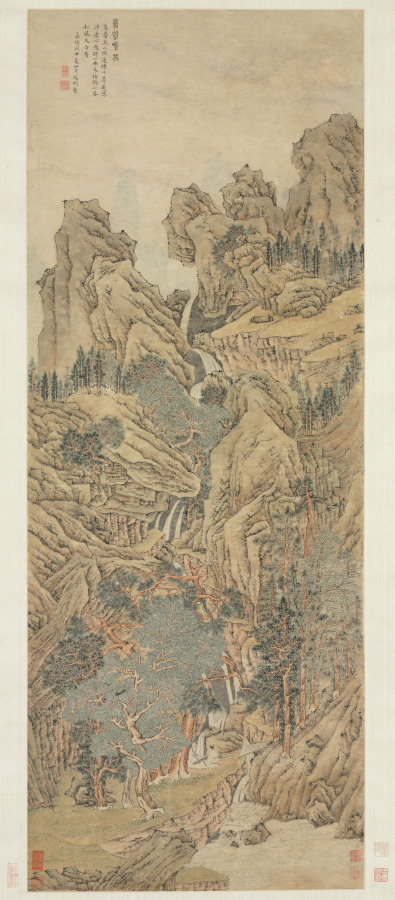 ↗
Wen Zhengming
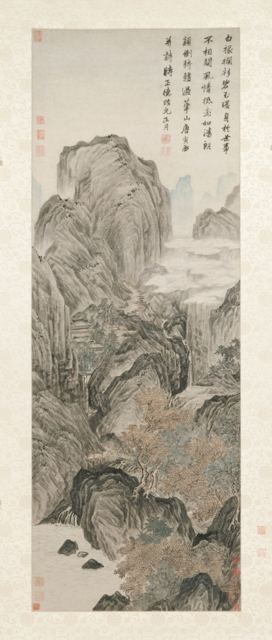 ↗
Tang Yin