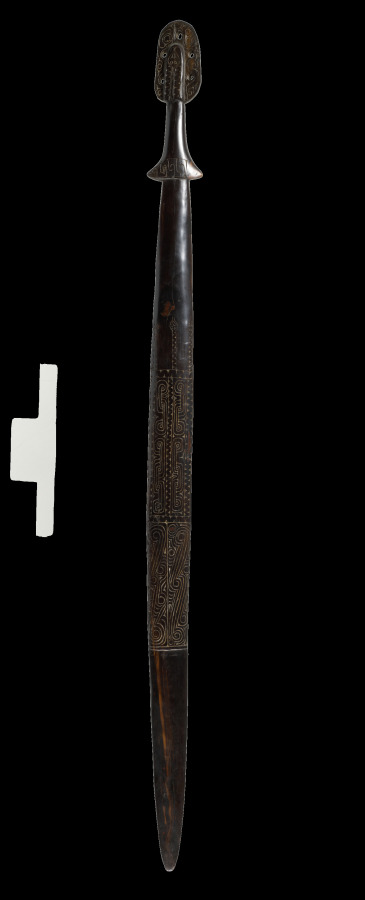
 ↗
Melanesia, New Guinea, Massim Area, Trobriand Islands, 20th century · before 1930
Club
Creator not recorded
The Mary Spedding Milliken Memorial Collection, Gift of William Mathewson Milliken · The Cleveland Museum of Art
Image licence: CC0 · Image policy · Museum record & image source ↗
Creator not recorded by the museum
Imagine the suspended box from underneath. Decoration that a tabletop view relegates to a lower edge can become the most visible part in the house.
Site interpretation and practical exercises. Historical and technical evidence is linked below.
Sources for context The Cleveland Museum of Art ↗
Read alongside
Decorated with low-relief spiral designs and small carved figures at each end, the treasure box was used to store ornaments worn by chiefs: feathers of the huia bird, combs, and pendants (hei-tiki). Because the heads and necks of high-ranking Maori chiefs were tapu, or sacred, their personal adornments were dangerous to children or individuals of lower rank. Treasure boxes were therefore hung from the rafters of the chief's house. Boxes like this one were in use when Captain Cook visited New Zealand in 1769-70.
Collection text · The Cleveland Museum of Art · CC0A wakahuia could hang from the rafters with treasured ornaments inside. Imagine seeing this box from below rather than looking down into it. The figures at its ends and the carving on its outer surfaces take on a different importance. For a design of your own, draw the object from the height at which someone would actually encounter it.
Site study note · catalogue facts and visual interpretation
Check the museum record ↗↗Creator not recorded
 ↗
Creator not recorded
 ↗
Creator not recorded
 ↗
Creator not recorded