 ↗
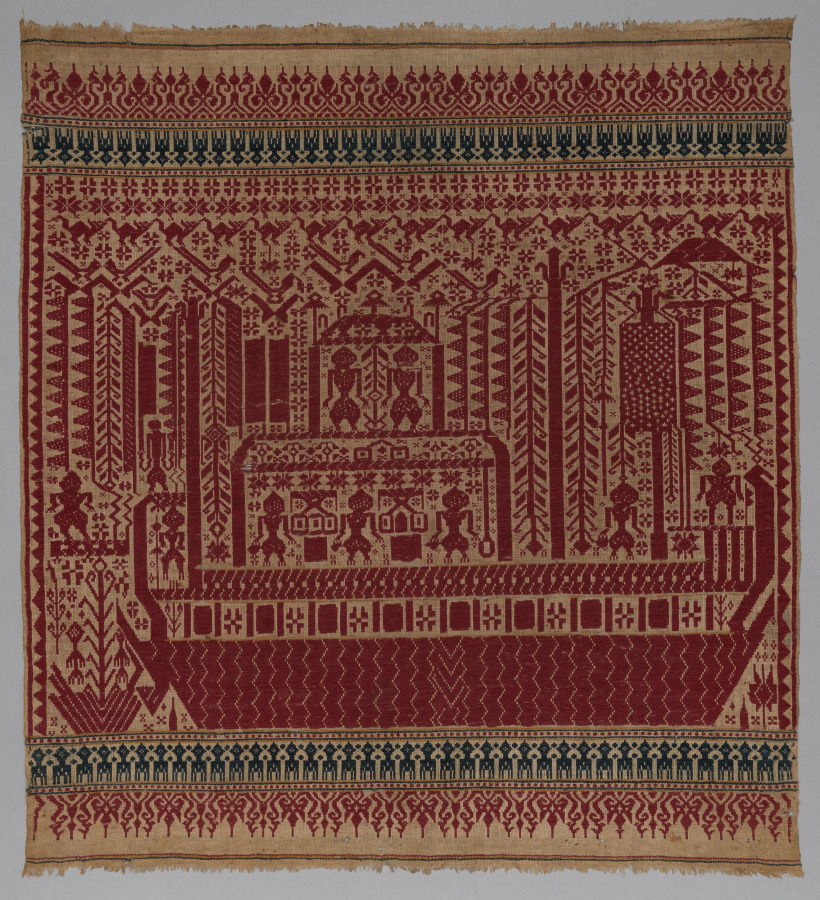
Indonesia, Sumatra, Lampung, 19th century · 1800s
Tampan Pasisir (Ship Cloth)
Creator not recorded
Purchase from the J. H. Wade Fund · The Cleveland Museum of Art
Image licence: CC0 · Image policy · Museum record & image source ↗
Creator not recorded by the museum
An elephant offers a sculptor two very different problems: a heavy body and a trunk capable of changing direction. Cleveland’s image description records a turned head and a trunk curving back across the chest. The curve draws attention through the compact mass rather than simply extending away from it. Movement can be suggested inside a stable overall shape.
The museum identifies sandstone and notes that weathering has softened the features. Smoothness today should not automatically be credited to the artist’s original handling. The record locates the sculpture at Tra-Kieu in present-day Vietnam, around 900–950, within the Cham cultural setting. It notes Indian stylistic connections, but does not provide a named maker or an individual life story.
Make a silhouette of a bulky animal, then change only the direction of its head. Next add a single curved line for a trunk or neck. Notice how little needs to change before the animal appears to attend to something. Keep this as a formal experiment; a lively pose alone cannot tell us the original sculpture’s religious or architectural function.
Site interpretation and practical exercises. Historical and technical evidence is linked below.
Sources for context Cleveland — Elephant ↗
Section sources checked 2026-11-22
Read alongside
The Cham kingdom was located in present-day central Vietnam and was a powerful rival of the Khmer in Cambodia. During the time when this charming, naturalistic elephant sculpture was made, the Cham were actively absorbing stylistic elements from India.
Collection text · The Cleveland Museum of Art · CC0↗Creator not recorded
 ↗
Creator not recorded
 ↗
Creator not recorded
 ↗
Creator not recorded