 ↗
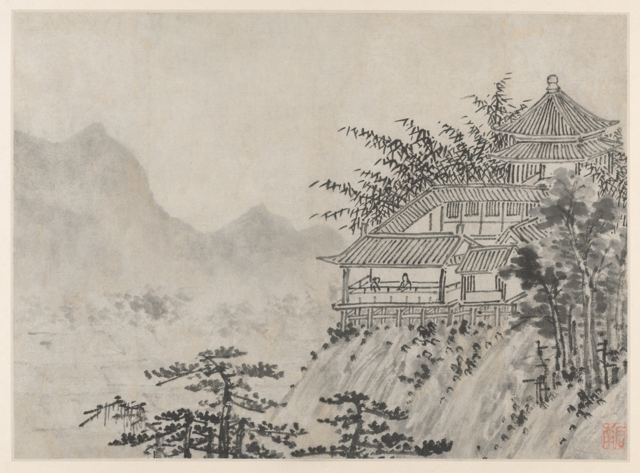
China, Ming dynasty (1368–1644) · after 1490
The Thousand Acres of Clouds, from Twelve Views of Tiger Hill, Suzhou
Shen Zhou
#705B43#735E45#52463A#64533F#6C5840#A6937BEstimated from six colour groups in the museum image, including visible paper or borders. Reproduction and lighting affect the result; these are image-area proportions, not pigment measurements.
John L. Severance Fund · The Cleveland Museum of Art
Image licence: CC0 · Image policy · Museum record & image source ↗
Compare the stalk's continuous bend with the quick turns of the leaves. Try describing the same gust with two kinds of mark instead of drawing the wind itself.
Site interpretation and practical exercises. Historical and technical evidence is linked below.
Sources for context The Cleveland Museum of Art ↗
Read alongside
Bamboo is an evergreen plant that does not break under the weight of snow or the force of the wind, and thus became a favorite motif in literati painting and Chan Buddhism as a metaphor for the virtue of not yielding to worldly temptations. Xuechuang, also known as monk Puming, was a native of Songjiang, near Shanghai, who spent his life as a monk in Suzhou. In 1338, he presided over Yunyan temple on Tiger Hill. Here, he masterfully depicts a bamboo gently bent in a subtle breeze. Puming’s paintings were revered in Japan and Korea.
Collection text · The Cleveland Museum of Art · CC0Wind is invisible, so Puming gives us something that can register its force. Follow a stalk through its bend and then see how far the leaves depart from its direction. The bamboo's association with constancy gains force from that small contradiction: it yields visibly and remains standing. Try showing wind without drawing a single wind line.
Site study note · catalogue facts and visual interpretation
Check the museum record ↗↗Shen Zhou
 ↗
Shitao
 ↗
Wen Zhengming
 ↗
Tang Yin