 ↗
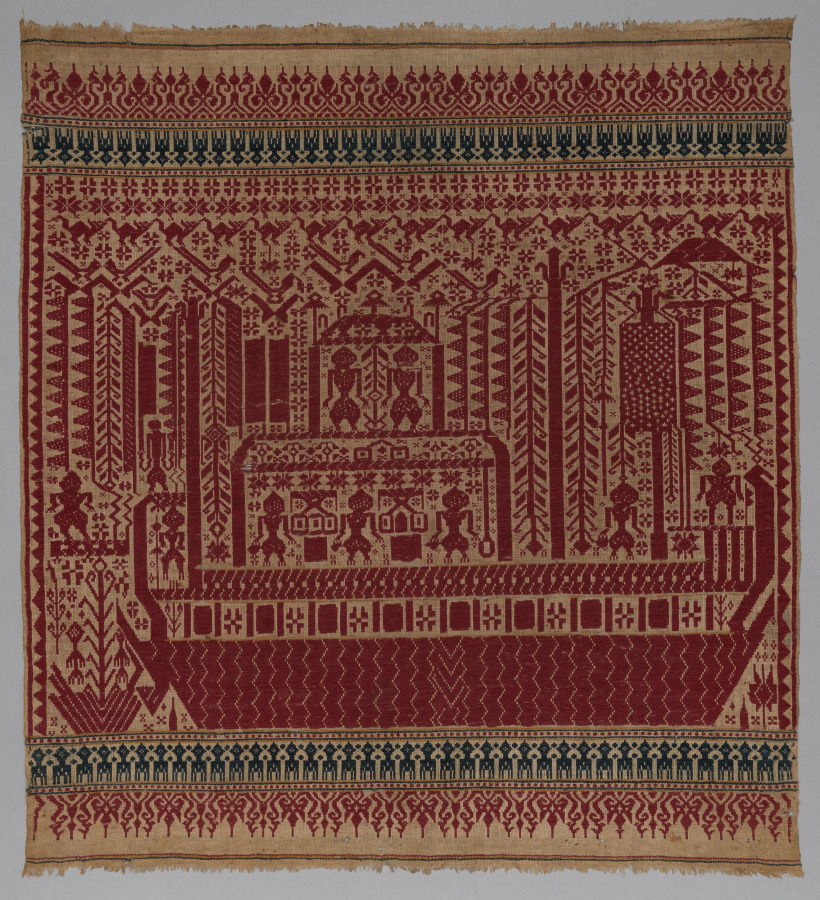
Indonesia, Sumatra, Lampung, 19th century · 1800s
Tampan Pasisir (Ship Cloth)
Creator not recorded
Gift of Mrs. James J. Tracy · The Cleveland Museum of Art
Image licence: CC0 · Image policy · Museum record & image source ↗
Creator not recorded by the museum
A sarong becomes cylindrical when worn. Join the left and right edges of a paper thumbnail and inspect where a flat pattern now meets itself.
Site interpretation and practical exercises. Historical and technical evidence is linked below.
Sources for context The Cleveland Museum of Art ↗
Read alongside
Batiks made in the North Coast region of Java, specifically in Pekalongan, were influenced by both Indian and European motifs due to the Dutch presence in Indonesia. In this sarong we see a mixture of Indian and European flowers including jasmine, lilac, and daffodil. Batik is a wax-resist dyeing technique used throughout Java. Hot wax is applied with a tool known as a canting and a design is hand drawn with incredible skill. This sarong was then dyed with indigo, a well sought after and culturally important natural dye. Areas on the fabric with wax will not accept the indigo dye, hence the term wax-resist.
Collection text · The Cleveland Museum of Art · CC0↗Creator not recorded
 ↗
Creator not recorded
 ↗
Creator not recorded
 ↗
Creator not recorded