 ↗
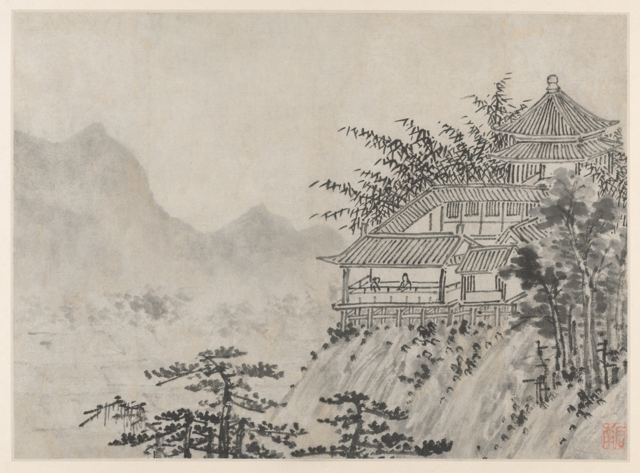
China, Ming dynasty (1368–1644) · after 1490
The Thousand Acres of Clouds, from Twelve Views of Tiger Hill, Suzhou
Shen Zhou
#CFBBA2#B39D82#D3C0A7#C2AE94#CCB395#DBC6AAEstimated from six colour groups in the museum image, including visible paper or borders. Reproduction and lighting affect the result; these are image-area proportions, not pigment measurements.
Grace Rainey Rogers Fund · The Cleveland Museum of Art
Image licence: CC0 · Image policy · Museum record & image source ↗
Creator not recorded by the museum
Begin on the text side of the leaf. An arrival at a merchant's house has a before and an after; turning the page changes how much of that story a reader knows at once.
Site interpretation and practical exercises. Historical and technical evidence is linked below.
Sources for context The Cleveland Museum of Art ↗
Read alongside
In this intense painting, Bahram Gur plunges his sword into the breast of a dragon. A favorite character from Iran's pre-Islamic history, Bahram Gur (reigned 420–38 CE) was a popular ruler of the Sasanian dynasty and a great hunter. He took the name "Gur," meaning onager (a wild ass), because it was his preferred game, although he also excelled at killing dragons. As evidenced by this illustration's rock formations, tree trunk, and dragon, Iranian painting in the Mongol period borrowed numerous stylistic and spatial elements from Chinese models. With the surging landscape and writhing dragon rendered with equal energy, this is a picture of extraordinary unity and concentration.
Collection text · The Cleveland Museum of Art · CC0↗Shen Zhou
 ↗
Shitao
 ↗
Wen Zhengming
 ↗
Tang Yin