 ↗
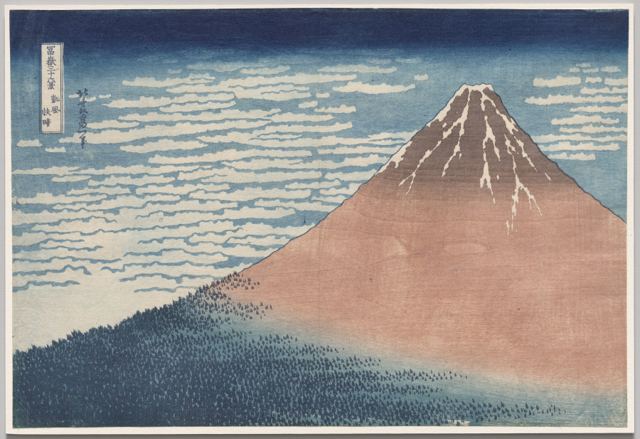
Japan, Edo period (1615–1868) · early 1830s
South Wind, Clear Sky, from Thirty-Six Views of Mount Fuji
Katsushika Hokusai
Bequest of James Parmelee · The Cleveland Museum of Art
Image licence: CC0 · Image policy · Museum record & image source ↗
The dark lower area and clearer summit make weather feel local rather than uniform. Instead of covering the whole sheet with rain marks, the design lets a boundary between dark and light carry much of the story. Read from the base to the summit, then reverse direction. One route can feel like an escape from the storm, while the other moves towards it. This describes a possible viewing experience, not a recorded statement of Hokusai’s intention.
The lightning has little area, yet its abrupt angular direction differs sharply from the mountain’s larger contours. It makes the dark region legible as active weather. This is why a palette percentage cannot rank the importance of details. A tiny shape can identify an event. Compare Red Fuji, where the slope and cloud pattern can be studied without the same sudden interruption.
Cleveland suggests that the print was probably conceived as a counterpart to the clear-weather view. That uncertainty should stay visible. For a drawing exercise, use the same hill outline twice. Change the distribution of dark and light areas, then add one short angular mark to only one version. Ask another viewer what seems to be happening before revealing your intended story. Their answer tests whether the visual evidence is doing the work.
Site interpretation and practical exercises. Historical and technical evidence is linked below.
Sources for context Cleveland Museum of Art · Rain Below the Mountain ↗
Section sources checked 2026-11-22
Read alongside
Hokusai probably composed this print as a complement to Mt. Fuji in Clear Weather (see CMA 1930.189) and to illustrate the mountain’s majesty in different weather. Here, a sudden shower covers most of the mountain’s base and slope with dark clouds.
Collection text · The Cleveland Museum of Art · CC0↗Katsushika Hokusai
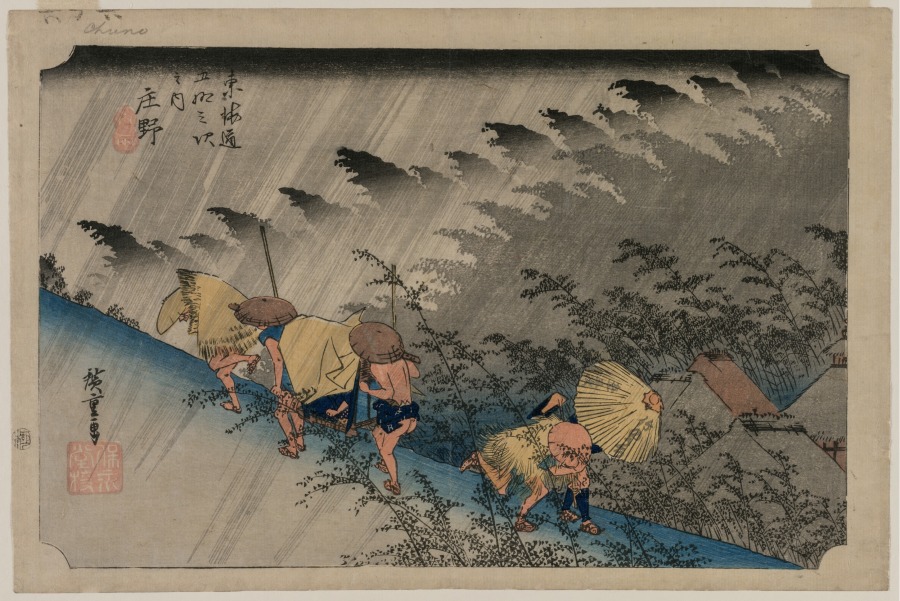 ↗
Utagawa Hiroshige
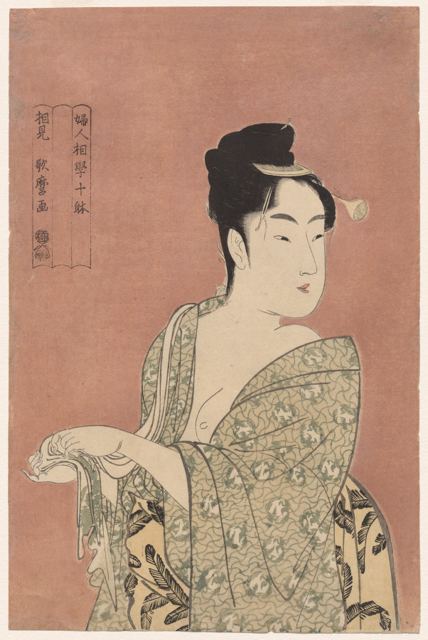 ↗
Kitagawa Utamaro
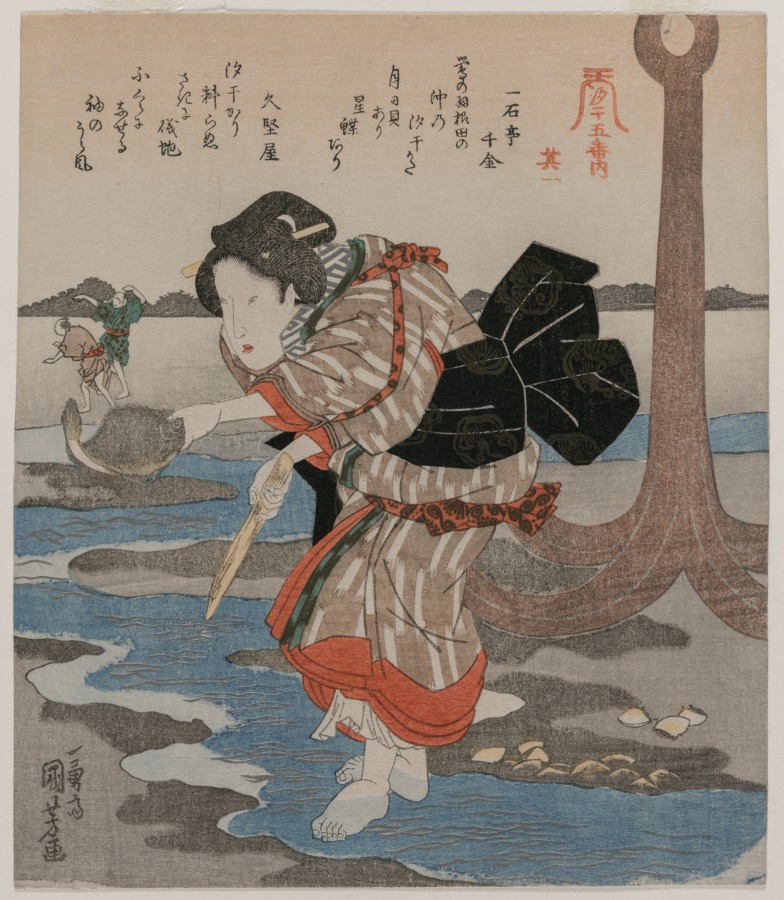 ↗
Utagawa Kuniyoshi