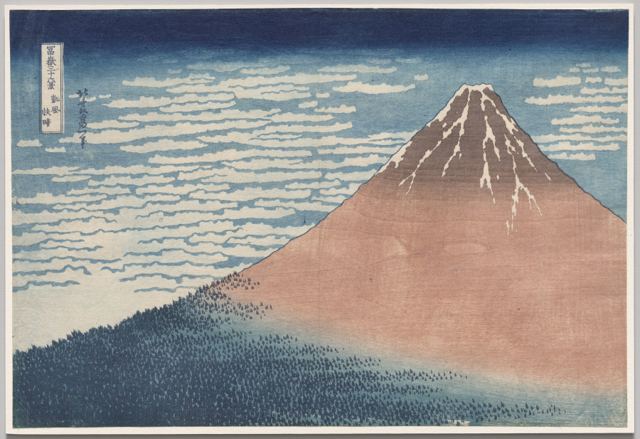
 ↗
Japan, Edo period (1615–1868) · early 1830s
South Wind, Clear Sky, from Thirty-Six Views of Mount Fuji
Katsushika Hokusai
H. O. Havemeyer Collection, Bequest of Mrs. H. O. Havemeyer, 1929 · The Metropolitan Museum of Art
Image licence: CC0 · Image policy · Web image resized for display. · Museum record & image source ↗
Follow the outline of the large wave and then find Mount Fuji. Both give us a pointed, pale shape, but they operate at very different scales. The wave curls over the boats while the mountain sits farther away. That repeated shape connects two distant parts of the image. It also creates an unstable first impression: a peak of water can briefly echo a peak of land. The boats help us recover scale and understand how exposed the people are.
The Met’s scientific study found that printers combined indigo and Prussian blue, including overlapping impressions, to produce different depths of blue. That finding gives us a more precise account than saying the work has a blue palette. The design had to become carved blocks, and those blocks had to be inked, aligned and pressed. Hokusai’s drawing and the printers’ decisions belong in the same story. The technical findings concern examined impressions, so they should not be treated as measurements of every surviving copy.
The curling contour gives the eye a route, while the small fingers of foam repeatedly interrupt that route. Read the image first as a silhouette, ignoring the interior blue bands. Then restore those bands. The silhouette gives the broad movement; the inner divisions make that movement feel layered. This is a useful distinction when comparing a woodblock print with a painting whose edges dissolve into adjacent brushmarks. A firm boundary can carry motion rather than merely fence in an object.
Draw one curved foreground shape and a smaller angular shape far behind it. Add a human-sized object between them, such as a boat, bicycle or doorway. Make a second version without that object. Notice how the scale becomes less certain. This exercise borrows a compositional relationship rather than tracing Hokusai’s wave. It can work in a landscape, poster or photograph.
Site interpretation and practical exercises. Historical and technical evidence is linked below.
Sources for context The Metropolitan Museum of Art · The Great Wave: Anatomy of an Icon ↗
Section sources checked 2026-11-22
Read alongside
The arching wave and distant Mount Fuji create a forceful contrast of scale. Printed contours and flat colour organise the breaking water. This is a separate museum impression of the famous design, with its own accession record.
Site study note · based on the linked catalogue↗Katsushika Hokusai
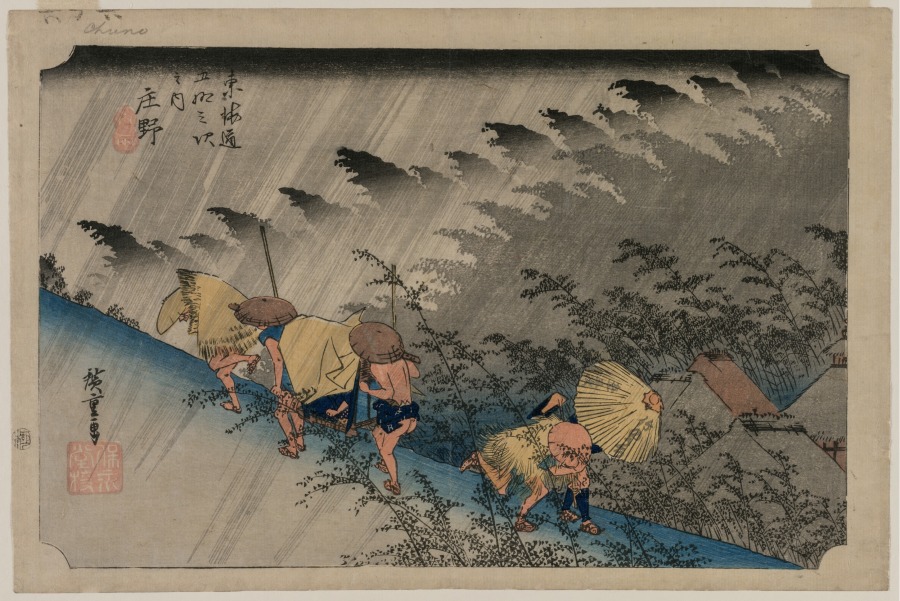 ↗
Utagawa Hiroshige
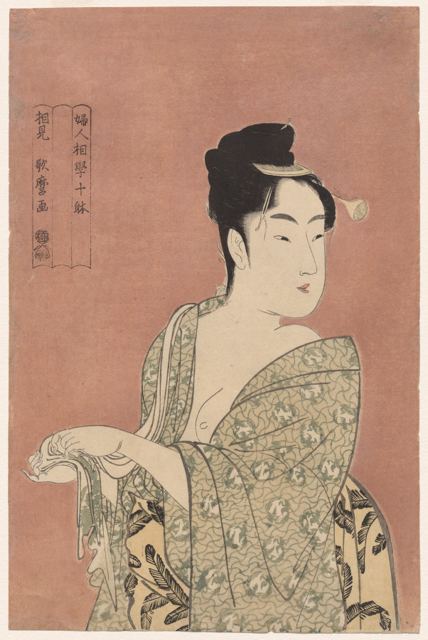 ↗
Kitagawa Utamaro
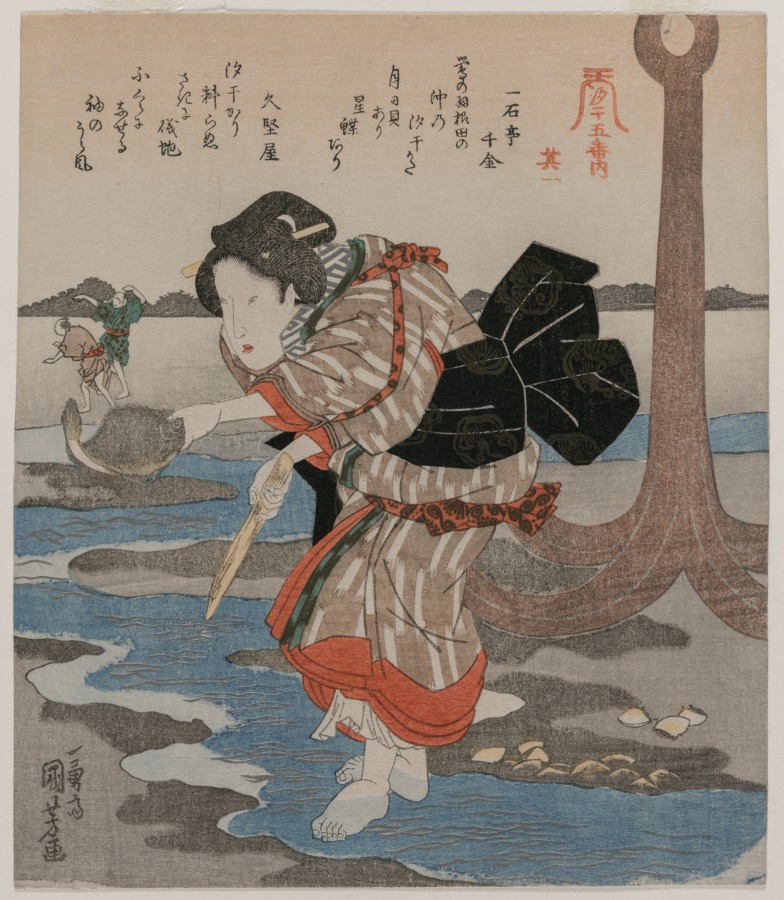 ↗
Utagawa Kuniyoshi